Etiqueta: First-time manager training

  • Mindslines Leadership Development Camp: Data-Driven Trainning for Managers.

    Mindslines Leadership Development Camp: Data-Driven Trainning for Managers.

    Our leadership development camp is an intensive, immersive program designed for new and established managers looking to translate leadership theory into practice. We focus on building the skills that create high-performing teams, drive business results, and make your organization a place where people thrive. This is not a retreat; it’s where leadership practice creates performance.


    In today’s competitive landscape, the quality of your leadership can be the single greatest differentiator for your business. Yet, many managers are promoted for their technical skills, not their ability to lead. They are given the title but not the tools. A leadership development camp provides a focused, immersive environment to bridge that gap, equipping your managers with the practical abilities they need to inspire their teams and drive meaningful growth.

    At Mindslines, we believe that with practice comes performance. Our approach to leadership training is grounded in this philosophy. We’ve designed an intensive «camp» experience for professionals—a hands-on workshop where leaders can learn, apply, and master the core competencies of effective management in a structured, supportive setting.

    What is a Professional Leadership Development Camp?

    Unlike a youth summer camp, a professional leadership development camp is a rigorous, outcome-oriented program. It’s an accelerated learning experience designed to take managers out of their day-to-day routines and immerse them in a curriculum focused on practical skills and real-world application.

    The goal is simple: to transform managers into leaders. Participants engage in a series of workshops, simulations, peer-coaching sessions, and strategic exercises. They learn to handle difficult conversations, motivate diverse teams, and make data-informed decisions. It’s about building the muscle memory for leadership so that when challenges arise, your managers can respond with confidence and competence.

    Our Approach to Leadership Development for 2026

    Our mission is straightforward: We’re here to make “I love my manager” a common sentence. This begins with empowering managers to lead with empathy, clarity, and strategic insight. Our 2026 leadership development camp is built on a foundation of proven frameworks and hands-on application.

    We move beyond abstract theories and dive into the practical challenges your leaders face every day. We leverage data and personalized feedback to help each participant understand their unique strengths and opportunities for growth. This is about fostering a deeper connection with oneself and others, a crucial element for any successful leader. By focusing on connecting with ourselves and with others, we build leaders who are not only effective but also human-centric.

    The Core Competencies of Modern Leadership

    Our curriculum is designed to instill the essential traits every great leader needs. Often discussed as the «Cs of Leadership,» these pillars form the backbone of our camp.

    • Character: Leaders of integrity build trust. We focus on ethical decision-making and the importance of leading by example.
    • Communication: Clear, empathetic, and consistent communication can prevent misunderstandings and align teams. We practice active listening, providing constructive feedback, and articulating a compelling vision.
    • Competence: Leaders must be proficient not only in their functional area but also in the art of management itself. This includes strategic planning, delegation, and performance management.
    • Courage: We empower leaders to make tough decisions, have difficult conversations, and take calculated risks to drive innovation.
    • Connection (or Charisma): A leader’s ability to connect with their team on a human level fosters loyalty and engagement. We work on building self-awareness and social intelligence.

    The 70-20-10 Model in Action

    A core part of our philosophy is the 70-20-10 rule for leadership development. We believe that true growth doesn’t just happen in a classroom.

    • 10% Formal Training: This is the «camp» itself—the structured learning, workshops, and expert instruction that provide the foundational knowledge and frameworks.
    • 20% Social Learning: Participants learn immensely from each other. Through peer coaching, group problem-solving, and shared experiences, they gain new perspectives and build a valuable support network.
    • 70% On-the-Job Experience: This is where the real learning sticks. Our program is designed to be immediately applicable. We work with leaders to apply their new skills to real-world projects and challenges. With tools like our Ascend platform, we help organizations turn leadership data into decisions that matter, enabling continuous growth and proving the impact of your investment.

    Frequently Asked Questions

    What do you do at a leadership camp?

    At a professional leadership camp like ours, you participate in interactive workshops, realistic business simulations, one-on-one coaching, peer feedback sessions, and strategic planning exercises. The focus is on applying leadership concepts to real-world scenarios to build practical skills in communication, decision-making, and team motivation.

    What is the 70-20-10 rule for leaders?

    The 70-20-10 rule is a widely accepted model for leadership development. It states that 70% of learning comes from on-the-job experiences and challenges, 20% comes from social learning (mentors, peers), and 10% comes from formal, structured training courses and programs.

    What are the 5 C’s of leadership development?

    The 5 C’s of leadership are generally considered to be Character, Competence, Courage, Communication, and Connection (or Charisma). These five pillars represent the essential qualities that effective leaders must cultivate to build trust, drive results, and inspire their teams.

    What are the 7 C’s of leadership?

    The 7 C’s expand on the 5 C’s and typically include Communication, Character, Credibility, Competence, Courage, Conviction, and Compassion. This framework provides a comprehensive view of the qualities and behaviors that contribute to powerful and respected leadership.


    Forge Your Future Leaders

    Investing in a leadership development camp is an investment in the future of your organization. When you empower your managers with the skills and confidence to lead effectively, you create a culture of performance, engagement, and retention.

    Ready to make «I love my manager» a reality in your company? Contact the Mindslines team today to learn more about our 2026–2027 leadership development programs.
    »’
  • How to Build Accountability in Your Team as a New Manager

    How to Build Accountability in Your Team as a New Manager

    You’ve just stepped into your first management role, and everything feels like it’s going well — until you realize a key project deadline slipped through the cracks, and no one on your team seems to own it. Sound familiar? You’re not alone. According to Gallup, only 14% of employees strongly agree that performance reviews inspire them to improve, which points to a deeper problem: most teams lack a true culture of accountability from the start.

    Learning how to build accountability in your team as a manager is one of the most critical — and most misunderstood — skills in leadership. New managers often fall into one of two traps: they either avoid difficult conversations to stay likable, or they overcorrect and slip into micromanagement. Neither works. What your team actually needs is a clear, consistent framework that empowers people to own their results without you hovering over every decision.

    In this guide, you’ll discover practical, proven strategies to create a culture where accountability isn’t a punishment — it’s a shared standard everyone buys into. From setting crystal-clear expectations to having honest performance conversations, we’ll walk you through exactly what it takes to lead with confidence and build a high-performing team from day one.

    Why Accountability Is the #1 Skill Gap for New Managers

    If you’ve ever looked around at a struggling team and wondered why things keep falling through the cracks, the answer is often the same: accountability isn’t happening consistently. And the cost of that gap is steeper than most managers realize.

    Consider what the research tells us. According to Gallup, only about 30% of employees strongly agree that their manager holds them accountable for their performance goals — a staggering figure when you consider how directly that ties to output. A study from the American Society for Training and Development found that people are 65% more likely to meet a goal when they’ve committed to someone else, and that number jumps to 95% with regular accountability check-ins. McKinsey research has found that organizations with clear performance accountability structures are 2.2 times more likely to outperform their peers. Meanwhile, Harvard Business Review reports that employees who don’t feel accountable — or don’t see accountability modeled around them — are significantly more likely to disengage and eventually leave.

    For new managers, the accountability gap is especially common. You may be managing former peers, which makes difficult conversations feel personal. You might not yet have a clear framework for setting expectations, so you hesitate to enforce them. Or you simply weren’t trained to have these conversations — and that’s more common than you’d think.

    The ripple effects touch everything: team morale drops when high performers watch low performance go unaddressed, retention suffers as your best people lose faith in leadership, and overall productivity stalls. Building accountability isn’t about being tough — it’s about being fair, clear, and consistent. That starts with understanding what accountability actually looks like in practice.

    What the Data Says: Accountability Gaps Cost Teams More Than You Think

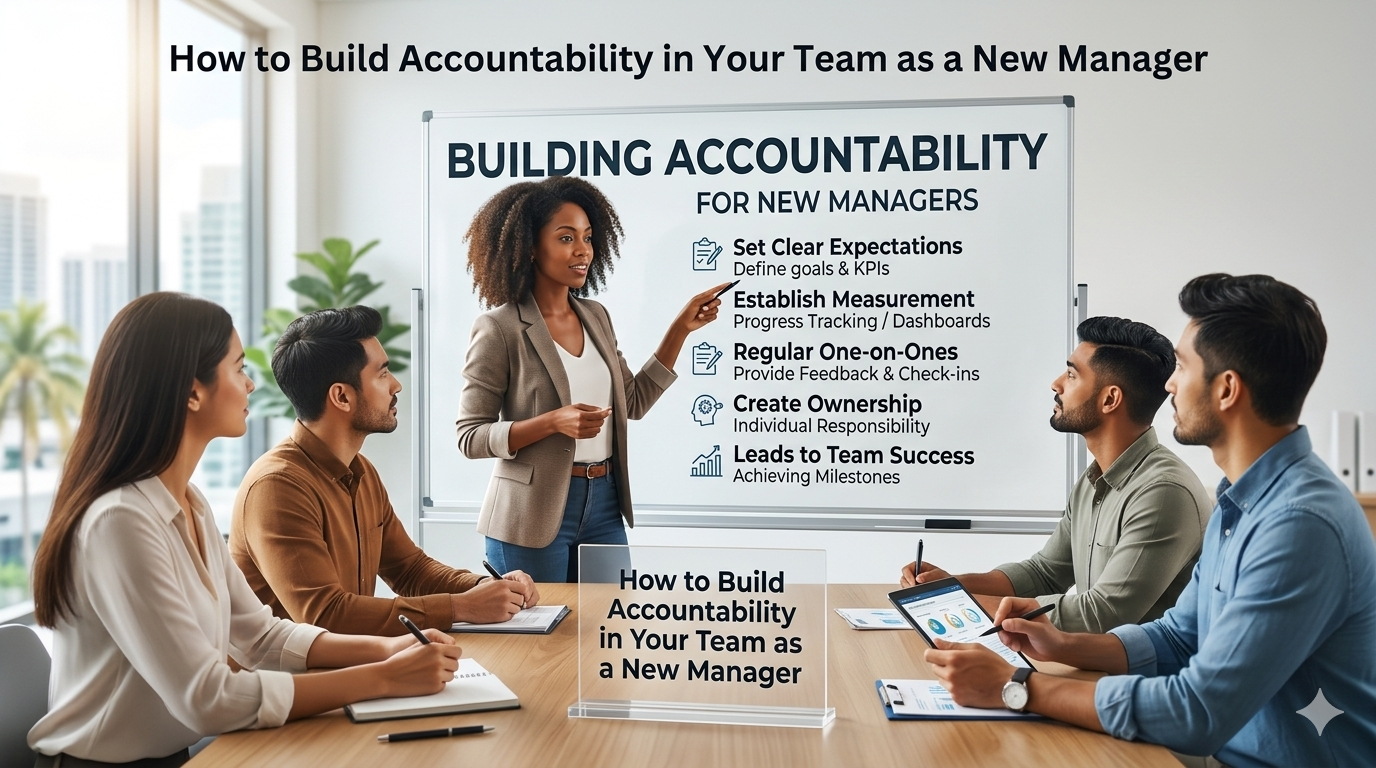
    Building accountability doesn’t happen by accident — it happens by design. The CLEAR Accountability Framework gives new managers a repeatable, structured approach to creating a culture where ownership thrives and results follow.

    C — Clarity: Every team member needs to know exactly what’s expected of them. Define goals, deadlines, and success metrics with precision. Vague expectations are the number one cause of missed accountability. Before a project begins, ask yourself: could my team member explain their responsibilities without my help?

    L — Leverage: Identify each person’s strengths and assign responsibilities that align with what they do best. When people work within their areas of competence and passion, they naturally take greater ownership. Leverage turns obligation into motivation.

    E — Engagement: Accountability only sticks when people feel genuinely connected to the outcome. Involve your team in goal-setting conversations rather than simply handing down directives. When employees co-create their targets, they invest in achieving them.

    A — Accountability Check-ins: Don’t wait until the deadline to find out things went sideways. Schedule regular, brief touchpoints — weekly or bi-weekly — to review progress, address blockers, and recalibrate if needed. These check-ins normalize accountability as a supportive habit, not a punitive measure.

    R — Recognition: Close the loop by acknowledging when accountability is demonstrated. Public praise, a simple thank-you, or a note in a team meeting can reinforce the behaviors you want to see repeated.

    The Framework in Action: Imagine a new manager onboarding a marketing coordinator for a product launch. Using CLEAR, she defines specific deliverables and deadlines (Clarity), assigns the coordinator the social media strategy because it’s her strongest skill (Leverage), includes her in shaping the campaign goals (Engagement), schedules weekly check-ins to monitor progress (Accountability Check-ins), and publicly recognizes her contributions at the launch debrief (Recognition). The result? A confident employee who delivers — and does it again.

    When applied consistently, CLEAR transforms accountability from a management buzzword into a lived team value.

    The CLEAR Accountability Framework Every New Manager Needs

    Building accountability doesn’t happen overnight, but the right actions taken early can set a powerful precedent for how your team operates. Here are five concrete steps you can start implementing this week.

    1. Define expectations in writing before your team’s next project kicks off. Schedule a brief meeting to co-create written role responsibilities and success metrics, then share a documented summary so every team member has a clear, reference-able standard to work toward.

    2. Launch a weekly accountability check-in — even just 15 minutes — where each team member shares one priority, one progress update, and one blocker. This simple rhythm builds transparency, surfaces issues early, and signals that follow-through is a core team value, not an afterthought.

    3. Implement a 30-60-90 day goal framework for yourself and your direct reports. Breaking larger objectives into time-bound milestones gives employees a manageable roadmap and gives you natural checkpoints to offer coaching, recalibrate priorities, and acknowledge wins along the way.

    4. Address accountability gaps immediately and privately when they arise. The first time a deadline is missed or an expectation goes unmet, have a direct, respectful one-on-one conversation — waiting too long sends the message that inconsistency is acceptable and quickly erodes the standards you’re trying to build.

    5. Model accountability yourself by owning your mistakes openly in front of your team. When you say 

    Step-by-Step: How to Build a Culture of Accountability From Day One

    Even managers with the best intentions can unknowingly undermine accountability on their teams. Here are four of the most common missteps — and how to course-correct before they become habits.

    Vague Expectations. When goals are fuzzy, accountability becomes impossible. Fix it by defining success in clear, measurable terms before the work begins — not after something goes wrong.

    Inconsistent Follow-Through. Checking in once and then disappearing sends the message that deadlines are optional. Fix it by building regular, structured check-ins into your routine so follow-up becomes a predictable part of your leadership rhythm.

    Confusing Accountability with Punishment. When team members associate accountability with blame, they hide mistakes instead of addressing them. Fix it by framing accountability conversations around problem-solving and growth, not consequences and criticism.

    Avoiding the Conversation Altogether. Many new managers sidestep difficult performance discussions to keep the peace — but silence only lets problems compound. Fix it by addressing issues early and directly, before small gaps become bigger patterns.

    Building accountability on your team isn’t about being the strictest manager in the room — it’s about creating a culture where expectations are clear, commitments are honored, and people feel safe owning both their wins and their setbacks. When done well, accountability becomes one of the most powerful drivers of team trust and performance.

    If you’re a first-time manager looking to develop these skills with confidence, mindslines.com offers coaching and training programs designed specifically for new leaders ready to build high-performing, accountable teams from day one.

  • How to Have Difficult Performance Conversations as a New Manager (With Scripts)

    How to Have Difficult Performance Conversations as a New Manager (With Scripts)

    Why Most New Managers Avoid Performance Conversations—And What It Costs

    You know the conversation needs to happen. Maybe it’s the team member who keeps missing deadlines, the colleague-turned-direct-report who’s coasting, or the otherwise great employee whose attitude is quietly poisoning team morale. You’ve rehearsed the opening line a dozen times. And yet, another week passes without the talk. If this sounds familiar, you’re not alone—research consistently shows that difficult performance conversations for managers rank among the most dreaded and most avoided responsibilities in leadership.

    For new managers especially, the struggle is real and deeply human. You want to be liked. You’re not entirely sure you have the authority yet. You worry about saying the wrong thing, damaging the relationship, or making the situation worse. So you wait, hoping the problem resolves itself. It rarely does.

    Avoidance has a cost—to your team’s performance, to your credibility, and ultimately to the employee who deserves honest feedback to grow. The good news? This is a skill, not a talent. It can be learned.

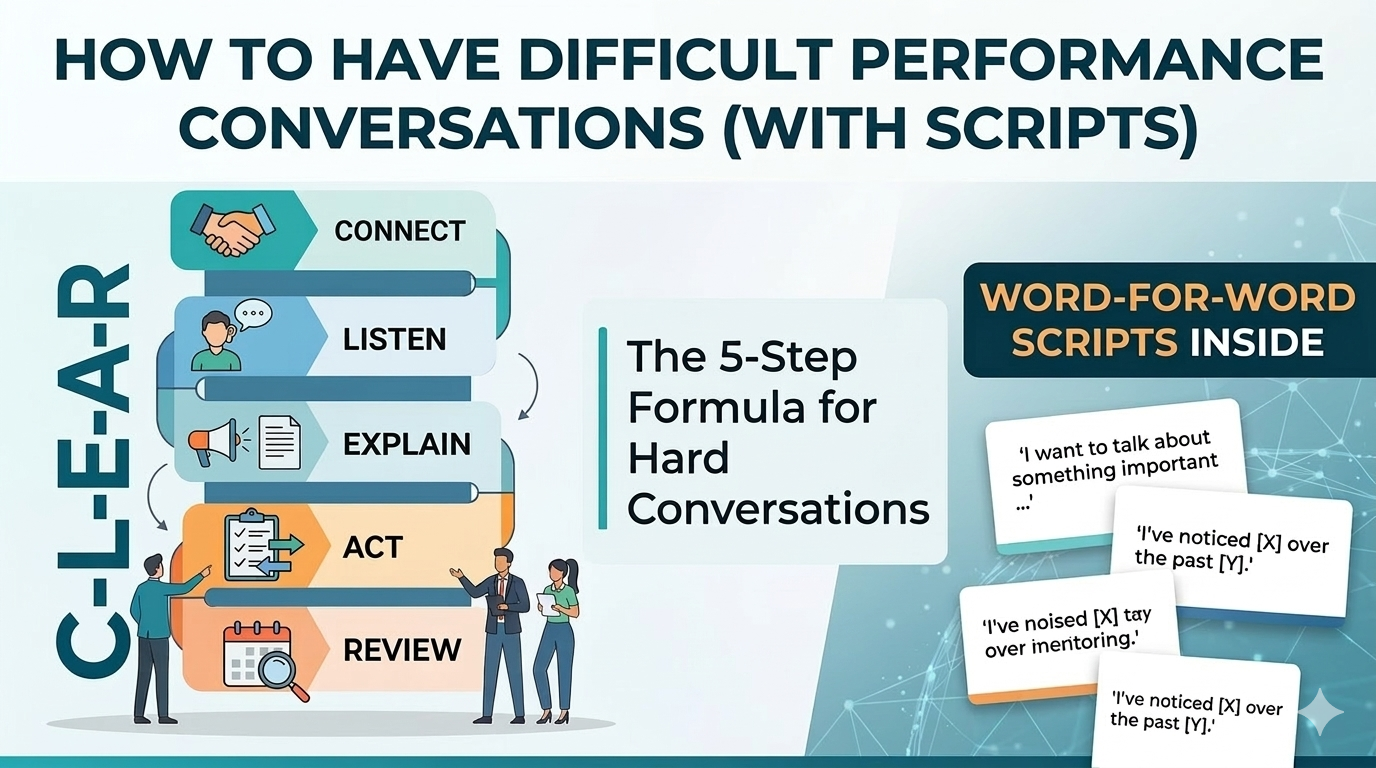
    In this guide, you’ll get a practical CLEAR framework for structuring these conversations with confidence, along with word-for-word scripts you can adapt starting today.

    The Data Behind Difficult Feedback: What Happens When Managers Stay Silent

    If you’ve been putting off a tough performance conversation, you’re not alone — but the cost of waiting is higher than most new managers realize.

    According to DDI’s Global Leadership Forecast, nearly half of managers (46%) admit they struggle to hold employees accountable through direct feedback conversations. And a 2024 Gallup workplace study found that only 26% of employees strongly agree that the feedback they receive helps them do better work. That gap isn’t just a communication problem — it’s a performance problem with a price tag.

    Here’s what the research consistently shows happens when managers go quiet:

    • Disengagement spreads fast. Gallup estimates that low engagement costs organizations approximately $8.8 trillion in lost productivity globally each year. A significant driver? Employees who feel their manager won’t address performance issues fairly. When high performers watch underperformance go unchecked, their own motivation quietly erodes.
    • Resentment builds in both directions. The Society for Human Resource Management (SHRM) reports that unresolved performance issues are among the top five reasons employees cite when leaving a job voluntarily — often framed as a management or culture problem rather than a compensation one.

    The CLEAR Framework: A Repeatable Structure for Hard Conversations

    One of the biggest reasons difficult performance conversations go sideways is that managers walk in without a structure. When you’re nervous, it’s easy to either over-explain, soften the message into meaninglessness, or skip straight to “fix this” without ever truly connecting. The CLEAR framework gives you a repeatable, five-step sequence that keeps the conversation focused, fair, and forward-moving — every time.

    C — Context: State the Specific Behavior, Not the Person

    Anchor the conversation in observable facts, not character judgments. This immediately lowers defensiveness because you’re discussing what happened, not who they are.

    The CLEAR Framework in Action

    L — Listen First: Open With a Question Before Delivering Feedback

    Before you diagnose, get curious. Asking a question first signals respect and often surfaces information that changes your entire approach.

    “Before I share my perspective, can you walk me through how those deadlines felt from your side?”

    E — Expectations: Restate the Standard Clearly

    Don’t assume the employee knows the expectation — say it plainly. Clarity here removes the “I didn’t know” loop that stalls progress.

    “The standard for this role is that all reports land in my inbox by 5 p.m. every Friday.”

    A — Action: Agree on a Specific, Observable Next Step

    Vague next steps create vague results. Collaborate on one concrete action so accountability is mutual, not imposed.

    “Let’s agree that you’ll send me a draft by Thursday noon so we have a buffer. Does that work for you?”

    R — Review: Set a Follow-Up Date

    Closing without a checkpoint sends the message that the conversation was just venting. A scheduled review shows you’re invested in their success.

    “Let’s reconnect on this in two weeks — I’ll put it on the calendar now.”

    When you follow CLEAR consistently, you shift difficult performance conversations from confrontations into coached problem-solving sessions. Employees feel heard before they feel judged, expectations are never ambiguous, and both parties leave with a shared commitment rather than a lingering sense of unresolved tension.

    Step-by-Step Guide to Delivering a Performance Conversation (With Word-for-Word Scripts)

    Difficult performance conversations for managers don’t have to spiral into conflict or awkwardness. Use the CLEAR framework — Connect, Listen, Explain, Act, Review — to keep the conversation focused and productive.

    Step 1: Prepare Before You Walk In

    Write down one or two specific, observable behaviors — not personality judgments. “Missed three deadlines in six weeks” is concrete. “Bad attitude” is not. Also decide your non-negotiable outcome: what must change, and by when.

    Step 2: Connect — Open With Respect

    Start by setting a calm, private tone. Avoid ambushing anyone in a hallway or open office.

    “I want to talk about something important, and I want to do it in a way that’s fair to you. I’ve noticed that [specific behavior] over the past [timeframe]. Can you help me understand what’s been happening?”

    This opening signals respect and invites dialogue rather than defensiveness.

    Step 3: Listen — Give Them Space to Respond

    After your opening, stop talking. Let the employee respond fully before you problem-solve. You may learn context that changes the picture — or you’ll confirm the issue is behavioral.

    Step 4: Explain — Be Clear About the Standard

    Once you’ve heard them out, name the expectation plainly.

    “The standard we need is [X]. I want to support you in getting there — what would help?”

    If defensiveness surfaces, acknowledge it briefly:

    “I hear that this feels frustrating. The goal here isn’t to put you on the spot — it’s to figure out how we move forward together.”

    Then redirect to solutions.

    Step 5: Act and Review — Close With a Concrete Plan

    End every conversation with a specific next step and a follow-up date. Vagueness kills accountability.

    “Let’s check in on [date] to see how [specific action] is going. I’ll document what we discussed so we’re both clear.”

    Document the conversation in writing — even a short email summary protects you both and reinforces seriousness.

    5 Common Mistakes New Managers Make in Feedback Conversations — And How to Fix Them

    Even well-intentioned managers stumble in difficult performance conversations. Here’s what to watch for — and how to course-correct.

    1. Waiting too long. When you delay addressing small issues, they quietly compound into bigger problems. By the time you finally speak up, the employee is blindsided and you’re managing a crisis instead of a conversation.
    2. Being vague instead of behavioral. Telling someone they need to “be more professional” or “show more initiative” gives them nothing actionable to change. Replace adjectives with observable actions and specific examples.