Categoría: articles

  • Communication as a Skill: The Definitive Guide for Leaders in 2026

    Communication as a Skill: The Definitive Guide for Leaders in 2026

    Communication is not a soft talent but a critical, learnable skill that directly impacts leadership effectiveness, team productivity, and overall business performance. Mastering key areas like clarity, active listening, nonverbal cues, and emotional intelligence is essential for any professional looking to thrive in 2026. This guide explores the core components of communication as a skill and provides actionable strategies for improvement.

    In today’s interconnected workplace, the ability to convey information, inspire action, and build strong relationships is paramount. Yet, many organizations still struggle with the consequences of poor communication: disengaged employees, misaligned projects, and a toxic culture. The truth is, effective communication is the bedrock of high-performing teams and the hallmark of exceptional leadership. The good news? It’s not an innate gift but a skill that can be honed. With practice comes performance.

    This guide will break down why treating communication as a skill is a game-changer for your professional development and your organization’s bottom line.

    Why Communication Is a Skill You Can (And Must) Develop

    For decades, communication was often mislabeled as a «soft skill»—an intangible, nice-to-have personality trait. This perception is not only outdated; it’s detrimental to growth. Communication is a technical and strategic skill set, composed of distinct, trainable competencies. Like learning a new software or a financial model, it requires understanding the principles, deliberate practice, and consistent refinement.

    Thinking of communication as a skill means you can:

    • Deconstruct it: Break it down into manageable components like verbal, nonverbal, written, and listening skills.
    • Measure it: Assess proficiency levels to identify strengths and weaknesses.
    • Improve it: Implement targeted exercises and strategies for development.

    Organizations that foster this mindset are better equipped to build the kind of leaders and teams that excel. They understand that making «I love my manager» a common sentence starts with equipping those managers with the tools to communicate effectively.

    Principle 1: Be Clear and Concise

    In a world saturated with information, clarity is currency. The ability to distill complex ideas into simple, understandable messages is a cornerstone of effective communication. Ambiguity leads to confusion, wasted effort, and errors. Whether you’re writing an email to your team or presenting a quarterly report to stakeholders, your goal should be to eliminate any room for misinterpretation.

    How to Achieve Clarity:

    • The «Bottom Line Up Front» (BLUF) Approach: Start with your main point or request. Don’t bury the lede in a long preamble.
    • Avoid Jargon: Use language that is accessible to your entire audience. If you must use technical terms, explain them.
    • Structure Your Message: Use headings, bullet points, and numbered lists to break up text and guide the reader’s eye. For verbal communication, outline your key points beforehand.
    • Ask for Playback: After explaining a complex topic, ask the listener to repeat the key takeaways in their own words. This confirms mutual understanding.

    Principle 2: Prepare Ahead of Time

    Spontaneity has its place, but in professional settings, preparation is the key to confident and impactful communication. Winging it can signal a lack of respect for others’ time and lead to rambling, unfocused conversations. Whether you have five minutes or five days, use the time to prepare.

    Areas Where Preparation Is Non-Negotiable:

    • Meetings: Every meeting should have a clear agenda, objective, and desired outcome. As a participant, review the agenda and come prepared with questions and input.
    • Presentations: Know your audience, your material, and your key messages inside and out. Rehearse your delivery to refine your pacing and timing. anticipate potential questions.
    • Difficult Conversations: Whether giving constructive feedback or addressing a conflict, planning your talking points is crucial. Think about the ideal outcome and the most constructive path to get there.

    Principle 3: Be Mindful of Nonverbal Communication

    The old adage that «it’s not what you say, it’s how you say it» is backed by decades of research. Nonverbal cues—often referred to as Body Language—can reinforce, contradict, or even completely override your spoken words. In a hybrid workplace, being adept at reading and using nonverbal signals is more important than ever, both in person and on screen.

    Key Nonverbal Cues to Master:

    • Eye Contact: In most Western cultures, including the United States, strong eye contact conveys confidence, sincerity, and engagement.
    • Posture and Gestures: An open posture (uncrossed arms and legs) signals approachability. Purposeful hand gestures can help illustrate your points, but avoid fidgeting, which can signal nervousness.
    • Facial Expressions: Your face is a powerful tool for conveying emotion. A genuine smile can build rapport, while a furrowed brow can signal concern or confusion.
    • Video Call Etiquette: On camera, ensure you are looking at the lens (not just the screen), that your lighting is good, and that your background is professional. Nod and provide visual feedback to show you are engaged.

    Principle 4: Watch Your Tone

    Closely related to nonverbal communication, your tone of voice can dramatically alter the meaning of your message. A sarcastic tone can turn a compliment into an insult. A flat, monotone voice can make exciting news sound boring. This applies to both spoken and written communication.

    • In Speech: Vary your pitch, volume, and pace to keep listeners engaged and to emphasize key points. A lower, steady tone often conveys authority and calm, while a higher, faster pace can signal excitement or anxiety.
    • In Writing: Without the benefit of voice, tone is easily misconstrued in emails and messages. Reread your written communication to check for unintentional curtness or ambiguity. Using positive language and, when appropriate, emojis, can help convey a friendly and collaborative tone.

    Principle 5: Practice Active Listening for Deeper Connection

    Communication is a two-way street. Too often, we listen with the intent to reply rather than to understand. Active listening is the conscious effort to hear, comprehend, and retain the information being shared. It’s a skill that builds trust, minimizes conflict, and fosters genuine human connection.

    True connection is a core part of professional excellence, requiring us to be present and engaged. As we focus on connecting with ourselves and with others, we build the foundation for impactful collaboration.

    The Pillars of Active Listening:

    1. Pay Full Attention: Put away your phone, close unnecessary tabs, and make eye contact. Show the speaker they have your undivided attention.
    2. Withhold Judgment: Listen with an open mind. Allow the speaker to finish their thought without interruption.
    3. Reflect and Paraphrase: Rephrase the speaker’s key points in your own words. («So, if I’m understanding correctly, you’re concerned about the timeline for Q3.»)
    4. Ask Clarifying Questions: Probe for more detail to ensure you have the full picture. («Can you tell me more about what happened after that?»)

    Principle 6: Build Your Emotional Intelligence (EQ)

    Emotional intelligence is the ability to perceive, evaluate, and regulate your own emotions while recognizing and influencing the emotions of others. In the context of communication as a skill, high EQ allows you to navigate complex social dynamics, provide empathetic feedback, and inspire your team.

    An emotionally intelligent communicator is someone who:

    • Is Self-Aware: They understand their own emotional triggers and communication style.
    • Is Empathetic: They can put themselves in others’ shoes and understand their perspectives and feelings.
    • Manages Relationships: They are adept at building rapport, resolving conflict, and inspiring collaboration.

    Principle 7: Develop a Workplace Communication Strategy

    Great communication doesn’t happen by accident; it happens by design. For leaders, this means moving beyond personal skills to architecting a communication strategy for their entire team or organization. This involves setting clear expectations, providing the right tools, and creating feedback loops.

    A robust strategy should define the «what,» «who,» «when,» and «how» of communication. This is how you can effectively turn leadership data into decisions that matter with Ascend, by ensuring that insights are not just gathered, but also communicated in a way that drives action.

    Elements of a Communication Strategy:

    • Channel Guidelines: Define which tools to use for which purpose (e.g., Slack for quick questions, email for formal announcements, a project management tool for status updates).
    • Meeting Cadence: Establish a rhythm for team check-ins, one-on-ones, and all-hands meetings.
    • Feedback Culture: Create safe, structured opportunities for giving and receiving constructive feedback.

    Frequently Asked Questions About Communication Skills

    Why is communication considered a skill?
    Communication is considered a skill because it is a set of abilities that can be learned, practiced, and improved over time. It is not an innate talent one is simply born with. Like any other skill, it can be broken down into specific techniques—such as active listening, clarity, and nonverbal awareness—that can be systematically developed.

    What are the 5 key communication skills?
    While there are many, five of the most critical communication skills in a professional context are: 1. Active Listening (fully concentrating on what is being said), 2. Clarity and Conciseness (the ability to convey messages simply), 3. Nonverbal Communication (understanding and using body language), 4. Emotional Intelligence (managing your emotions and perceiving others’), and 5. Giving and Receiving Feedback constructively.

    Is communication a skill or skills?
    It’s both. «Communication» can be viewed as a single, broad skill of successfully conveying and receiving information. However, this macro-skill is comprised of numerous micro-skills, such as public speaking, writing, active listening, persuasion, and nonverbal communication. To become a great communicator, you must develop proficiency across this entire suite of skills.

    How do I professionally say I have good communication skills?
    Instead of simply stating «I have good communication skills,» demonstrate it using specific examples. Use the STAR method (Situation, Task, Action, Result). For instance: «In my previous role (Situation), we were facing project delays due to team misalignment (Task). I initiated and facilitated daily 15-minute stand-up meetings to ensure everyone was on the same page (Action). As a result, we improved our project delivery time by 20% and eliminated confusion (Result).»

    How Can You Improve Your Communication Skills?
    You can improve by engaging in deliberate practice. This includes seeking feedback from peers and mentors, recording yourself speaking to analyze your delivery, taking courses or workshops, practicing active listening in daily conversations, and writing regularly to improve clarity. The key is consistent effort and a willingness to learn.

    What is effective communication?
    Effective communication is the process of exchanging ideas, thoughts, and information such that the purpose or intention is fulfilled in the best possible manner. The ultimate goal is shared understanding. It’s not just about transmitting a message, but about ensuring the receiver understands the message as the sender intended.

    Take the Next Step in Your Communication Journey

    Mastering communication as a skill is a continuous journey, not a destination. From the boardrooms of New York to virtual teams across the globe, the leaders and professionals who invest in this skill are the ones who will build the most resilient, innovative, and engaged teams of tomorrow.

    By focusing on clarity, preparation, active listening, and a strategic approach, you can transform your interactions and drive meaningful results. Find more resources for professional growth and leadership on The Mindslines Blog.

    Ready to elevate your team’s leadership capabilities? Contact Mindslines today to learn how we help you build better managers and higher-performing teams.

  • Mindslines Leadership Development Camp: Data-Driven Trainning for Managers.

    Mindslines Leadership Development Camp: Data-Driven Trainning for Managers.

    Our leadership development camp is an intensive, immersive program designed for new and established managers looking to translate leadership theory into practice. We focus on building the skills that create high-performing teams, drive business results, and make your organization a place where people thrive. This is not a retreat; it’s where leadership practice creates performance.


    In today’s competitive landscape, the quality of your leadership can be the single greatest differentiator for your business. Yet, many managers are promoted for their technical skills, not their ability to lead. They are given the title but not the tools. A leadership development camp provides a focused, immersive environment to bridge that gap, equipping your managers with the practical abilities they need to inspire their teams and drive meaningful growth.

    At Mindslines, we believe that with practice comes performance. Our approach to leadership training is grounded in this philosophy. We’ve designed an intensive «camp» experience for professionals—a hands-on workshop where leaders can learn, apply, and master the core competencies of effective management in a structured, supportive setting.

    What is a Professional Leadership Development Camp?

    Unlike a youth summer camp, a professional leadership development camp is a rigorous, outcome-oriented program. It’s an accelerated learning experience designed to take managers out of their day-to-day routines and immerse them in a curriculum focused on practical skills and real-world application.

    The goal is simple: to transform managers into leaders. Participants engage in a series of workshops, simulations, peer-coaching sessions, and strategic exercises. They learn to handle difficult conversations, motivate diverse teams, and make data-informed decisions. It’s about building the muscle memory for leadership so that when challenges arise, your managers can respond with confidence and competence.

    Our Approach to Leadership Development for 2026

    Our mission is straightforward: We’re here to make “I love my manager” a common sentence. This begins with empowering managers to lead with empathy, clarity, and strategic insight. Our 2026 leadership development camp is built on a foundation of proven frameworks and hands-on application.

    We move beyond abstract theories and dive into the practical challenges your leaders face every day. We leverage data and personalized feedback to help each participant understand their unique strengths and opportunities for growth. This is about fostering a deeper connection with oneself and others, a crucial element for any successful leader. By focusing on connecting with ourselves and with others, we build leaders who are not only effective but also human-centric.

    The Core Competencies of Modern Leadership

    Our curriculum is designed to instill the essential traits every great leader needs. Often discussed as the «Cs of Leadership,» these pillars form the backbone of our camp.

    • Character: Leaders of integrity build trust. We focus on ethical decision-making and the importance of leading by example.
    • Communication: Clear, empathetic, and consistent communication can prevent misunderstandings and align teams. We practice active listening, providing constructive feedback, and articulating a compelling vision.
    • Competence: Leaders must be proficient not only in their functional area but also in the art of management itself. This includes strategic planning, delegation, and performance management.
    • Courage: We empower leaders to make tough decisions, have difficult conversations, and take calculated risks to drive innovation.
    • Connection (or Charisma): A leader’s ability to connect with their team on a human level fosters loyalty and engagement. We work on building self-awareness and social intelligence.

    The 70-20-10 Model in Action

    A core part of our philosophy is the 70-20-10 rule for leadership development. We believe that true growth doesn’t just happen in a classroom.

    • 10% Formal Training: This is the «camp» itself—the structured learning, workshops, and expert instruction that provide the foundational knowledge and frameworks.
    • 20% Social Learning: Participants learn immensely from each other. Through peer coaching, group problem-solving, and shared experiences, they gain new perspectives and build a valuable support network.
    • 70% On-the-Job Experience: This is where the real learning sticks. Our program is designed to be immediately applicable. We work with leaders to apply their new skills to real-world projects and challenges. With tools like our Ascend platform, we help organizations turn leadership data into decisions that matter, enabling continuous growth and proving the impact of your investment.

    Frequently Asked Questions

    What do you do at a leadership camp?

    At a professional leadership camp like ours, you participate in interactive workshops, realistic business simulations, one-on-one coaching, peer feedback sessions, and strategic planning exercises. The focus is on applying leadership concepts to real-world scenarios to build practical skills in communication, decision-making, and team motivation.

    What is the 70-20-10 rule for leaders?

    The 70-20-10 rule is a widely accepted model for leadership development. It states that 70% of learning comes from on-the-job experiences and challenges, 20% comes from social learning (mentors, peers), and 10% comes from formal, structured training courses and programs.

    What are the 5 C’s of leadership development?

    The 5 C’s of leadership are generally considered to be Character, Competence, Courage, Communication, and Connection (or Charisma). These five pillars represent the essential qualities that effective leaders must cultivate to build trust, drive results, and inspire their teams.

    What are the 7 C’s of leadership?

    The 7 C’s expand on the 5 C’s and typically include Communication, Character, Credibility, Competence, Courage, Conviction, and Compassion. This framework provides a comprehensive view of the qualities and behaviors that contribute to powerful and respected leadership.


    Forge Your Future Leaders

    Investing in a leadership development camp is an investment in the future of your organization. When you empower your managers with the skills and confidence to lead effectively, you create a culture of performance, engagement, and retention.

    Ready to make «I love my manager» a reality in your company? Contact the Mindslines team today to learn more about our 2026–2027 leadership development programs.
    »’

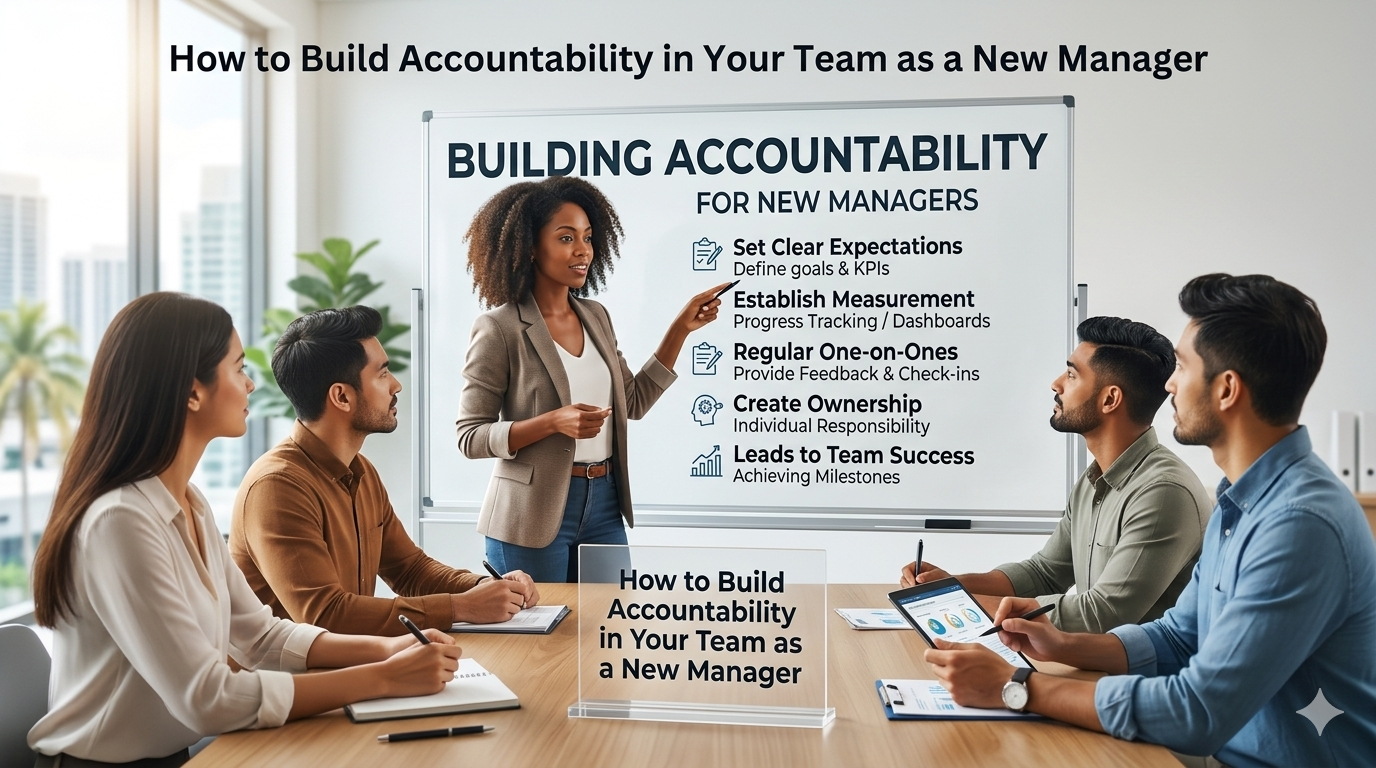
  • How to Build Accountability in Your Team as a New Manager

    How to Build Accountability in Your Team as a New Manager

    You’ve just stepped into your first management role, and everything feels like it’s going well — until you realize a key project deadline slipped through the cracks, and no one on your team seems to own it. Sound familiar? You’re not alone. According to Gallup, only 14% of employees strongly agree that performance reviews inspire them to improve, which points to a deeper problem: most teams lack a true culture of accountability from the start.

    Learning how to build accountability in your team as a manager is one of the most critical — and most misunderstood — skills in leadership. New managers often fall into one of two traps: they either avoid difficult conversations to stay likable, or they overcorrect and slip into micromanagement. Neither works. What your team actually needs is a clear, consistent framework that empowers people to own their results without you hovering over every decision.

    In this guide, you’ll discover practical, proven strategies to create a culture where accountability isn’t a punishment — it’s a shared standard everyone buys into. From setting crystal-clear expectations to having honest performance conversations, we’ll walk you through exactly what it takes to lead with confidence and build a high-performing team from day one.

    Why Accountability Is the #1 Skill Gap for New Managers

    If you’ve ever looked around at a struggling team and wondered why things keep falling through the cracks, the answer is often the same: accountability isn’t happening consistently. And the cost of that gap is steeper than most managers realize.

    Consider what the research tells us. According to Gallup, only about 30% of employees strongly agree that their manager holds them accountable for their performance goals — a staggering figure when you consider how directly that ties to output. A study from the American Society for Training and Development found that people are 65% more likely to meet a goal when they’ve committed to someone else, and that number jumps to 95% with regular accountability check-ins. McKinsey research has found that organizations with clear performance accountability structures are 2.2 times more likely to outperform their peers. Meanwhile, Harvard Business Review reports that employees who don’t feel accountable — or don’t see accountability modeled around them — are significantly more likely to disengage and eventually leave.

    For new managers, the accountability gap is especially common. You may be managing former peers, which makes difficult conversations feel personal. You might not yet have a clear framework for setting expectations, so you hesitate to enforce them. Or you simply weren’t trained to have these conversations — and that’s more common than you’d think.

    The ripple effects touch everything: team morale drops when high performers watch low performance go unaddressed, retention suffers as your best people lose faith in leadership, and overall productivity stalls. Building accountability isn’t about being tough — it’s about being fair, clear, and consistent. That starts with understanding what accountability actually looks like in practice.

    What the Data Says: Accountability Gaps Cost Teams More Than You Think

    Building accountability doesn’t happen by accident — it happens by design. The CLEAR Accountability Framework gives new managers a repeatable, structured approach to creating a culture where ownership thrives and results follow.

    C — Clarity: Every team member needs to know exactly what’s expected of them. Define goals, deadlines, and success metrics with precision. Vague expectations are the number one cause of missed accountability. Before a project begins, ask yourself: could my team member explain their responsibilities without my help?

    L — Leverage: Identify each person’s strengths and assign responsibilities that align with what they do best. When people work within their areas of competence and passion, they naturally take greater ownership. Leverage turns obligation into motivation.

    E — Engagement: Accountability only sticks when people feel genuinely connected to the outcome. Involve your team in goal-setting conversations rather than simply handing down directives. When employees co-create their targets, they invest in achieving them.

    A — Accountability Check-ins: Don’t wait until the deadline to find out things went sideways. Schedule regular, brief touchpoints — weekly or bi-weekly — to review progress, address blockers, and recalibrate if needed. These check-ins normalize accountability as a supportive habit, not a punitive measure.

    R — Recognition: Close the loop by acknowledging when accountability is demonstrated. Public praise, a simple thank-you, or a note in a team meeting can reinforce the behaviors you want to see repeated.

    The Framework in Action: Imagine a new manager onboarding a marketing coordinator for a product launch. Using CLEAR, she defines specific deliverables and deadlines (Clarity), assigns the coordinator the social media strategy because it’s her strongest skill (Leverage), includes her in shaping the campaign goals (Engagement), schedules weekly check-ins to monitor progress (Accountability Check-ins), and publicly recognizes her contributions at the launch debrief (Recognition). The result? A confident employee who delivers — and does it again.

    When applied consistently, CLEAR transforms accountability from a management buzzword into a lived team value.

    The CLEAR Accountability Framework Every New Manager Needs

    Building accountability doesn’t happen overnight, but the right actions taken early can set a powerful precedent for how your team operates. Here are five concrete steps you can start implementing this week.

    1. Define expectations in writing before your team’s next project kicks off. Schedule a brief meeting to co-create written role responsibilities and success metrics, then share a documented summary so every team member has a clear, reference-able standard to work toward.

    2. Launch a weekly accountability check-in — even just 15 minutes — where each team member shares one priority, one progress update, and one blocker. This simple rhythm builds transparency, surfaces issues early, and signals that follow-through is a core team value, not an afterthought.

    3. Implement a 30-60-90 day goal framework for yourself and your direct reports. Breaking larger objectives into time-bound milestones gives employees a manageable roadmap and gives you natural checkpoints to offer coaching, recalibrate priorities, and acknowledge wins along the way.

    4. Address accountability gaps immediately and privately when they arise. The first time a deadline is missed or an expectation goes unmet, have a direct, respectful one-on-one conversation — waiting too long sends the message that inconsistency is acceptable and quickly erodes the standards you’re trying to build.

    5. Model accountability yourself by owning your mistakes openly in front of your team. When you say 

    Step-by-Step: How to Build a Culture of Accountability From Day One

    Even managers with the best intentions can unknowingly undermine accountability on their teams. Here are four of the most common missteps — and how to course-correct before they become habits.

    Vague Expectations. When goals are fuzzy, accountability becomes impossible. Fix it by defining success in clear, measurable terms before the work begins — not after something goes wrong.

    Inconsistent Follow-Through. Checking in once and then disappearing sends the message that deadlines are optional. Fix it by building regular, structured check-ins into your routine so follow-up becomes a predictable part of your leadership rhythm.

    Confusing Accountability with Punishment. When team members associate accountability with blame, they hide mistakes instead of addressing them. Fix it by framing accountability conversations around problem-solving and growth, not consequences and criticism.

    Avoiding the Conversation Altogether. Many new managers sidestep difficult performance discussions to keep the peace — but silence only lets problems compound. Fix it by addressing issues early and directly, before small gaps become bigger patterns.

    Building accountability on your team isn’t about being the strictest manager in the room — it’s about creating a culture where expectations are clear, commitments are honored, and people feel safe owning both their wins and their setbacks. When done well, accountability becomes one of the most powerful drivers of team trust and performance.

    If you’re a first-time manager looking to develop these skills with confidence, mindslines.com offers coaching and training programs designed specifically for new leaders ready to build high-performing, accountable teams from day one.

  • Delegation Skills for First-Time Managers: How to Let Go and Lead

    Delegation Skills for First-Time Managers: How to Let Go and Lead

    You were promoted because you were exceptional at your job — the go-to person, the one who got things done. Now, as a first-time manager, the very thing that made you successful is the thing you need to release. This is the central paradox that trips up so many new leaders, and mastering delegation skills for first-time managers is the key to breaking through it.

    Here’s the uncomfortable truth: holding onto tasks because «it’s faster if I just do it myself» isn’t efficiency — it’s a ceiling. It limits your team’s growth, caps your impact, and quietly signals that you don’t trust the people you’re supposed to be leading. The shift from individual contributor to manager isn’t just a title change. It’s a fundamental rewiring of how you define your own success.

    The good news? Delegation is a learnable skill, not a personality trait. And once you crack it, everything changes — for you, your team, and your results.

    In this article, you’ll discover why delegation feels so difficult at first, the most common mistakes new managers make, and a practical step-by-step framework to start delegating with confidence, clarity, and control.

    Why Delegation Is the #1 Skill First-Time Managers Must Master

    The promotion felt like the finish line. In reality, it was the starting gun for an entirely different race — one where your old playbook of working harder and doing more will quietly sabotage your success.

    Here’s the uncomfortable truth most new managers learn too late: the skills that earned you the promotion are not the skills that will make you effective in the role. And nowhere is that gap more glaring than in delegation.

    Gallup research reveals that managers who delegate effectively generate 33% more revenue than their less-trusting counterparts. Yet studies consistently show that first-time managers spend more than 40% of their time on tasks that could — and should — be handled by their teams. That’s nearly half your week spent doing yesterday’s job instead of leading today’s.

    The cost compounds quickly. When managers can’t let go, they become the bottleneck. Projects stall, team members disengage, and burnout creeps in. The American Institute of Stress links managerial burnout directly to the inability to distribute workload — and it’s one of the leading reasons promising managers derail within their first two years.

    But the barriers are understandable. Fear of losing control, perfectionism, and a nagging distrust that «no one will do it quite right» are deeply human responses to newfound responsibility. They feel like caution; they function like ceiling.

    Effective delegation isn’t about doing less. It’s about unlocking team growth, building your own strategic capacity, and creating a operation that scales beyond any single person — including you.

    The SMART Delegation Framework for New Managers

    Delegation isn’t just about handing off tasks — it’s about setting people up to succeed. Use the SMART Delegation Framework to make every handoff intentional and effective.

    Scope: Start by defining exactly what needs to be done. Describe the expected output in concrete terms and establish clear quality standards. Vague instructions lead to disappointing results, so the more specific you are upfront, the less rework you’ll face later.

    Match: Not every task belongs to every person. Align the work to a team member whose existing skills fit the challenge and whose growth goals benefit from taking it on. The right match builds confidence and keeps your team developing.

    Authority: One of the biggest mistakes new managers make is delegating responsibility without delegating authority. Be explicit about which decisions your team member can make independently and which ones require your input. This clarity removes hesitation and speeds up execution.

    Resources: Before someone can perform, they need the right tools, information, and access. Confirm they have everything required — data, software permissions, budget, or key contacts — before the work begins. Removing blockers early prevents frustrating delays.

    Timeline and Check-ins: Set clear milestones and agree on check-in points upfront. The goal is accountability, not surveillance. Scheduled touchpoints give you visibility without hovering, and they give your team member a safety net if challenges arise.

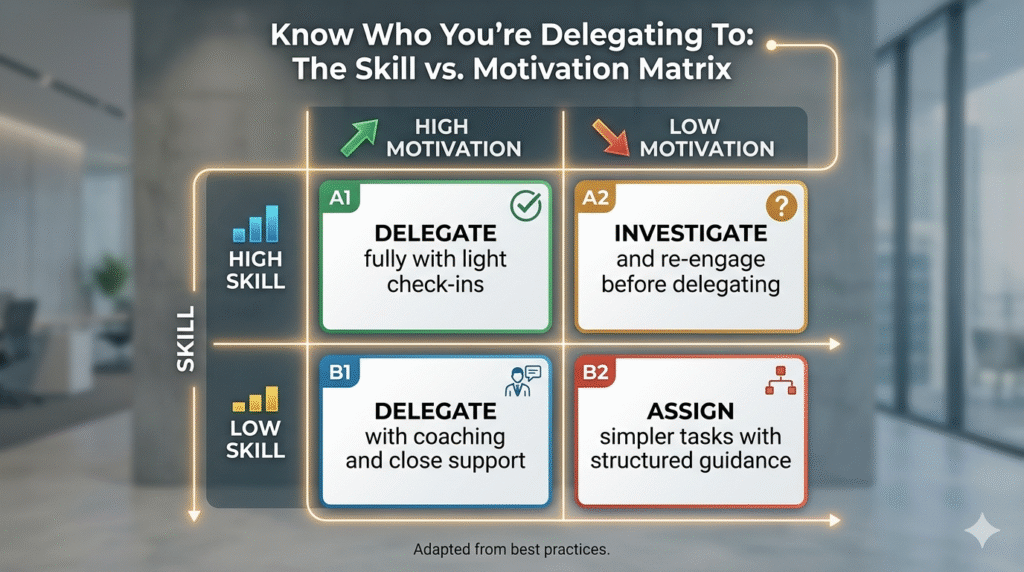
    Know Who You’re Delegating To: The Skill vs. Motivation Matrix

    Before delegating, quickly assess where your team member falls in this simple 2×2 matrix:

    Skill vs Delegation Matrix
    Skill vs Delegation Matrix

    Matching your delegation style to someone’s current skill and motivation level isn’t micromanaging — it’s smart leadership.

    5 Steps to Master Delegation as a First-Time Manager

    Delegation doesn’t happen by accident — it’s a skill you build deliberately. Follow these five steps to start handing off work with confidence.

    Step 1: Audit Your Task List

    Start by writing down everything on your plate. Then draw a hard line: which tasks require your specific authority or expertise, and which ones could realistically be handled by someone on your team? Be honest. Most first-time managers discover that far more tasks are delegable than they initially assumed.

    Step 2: Match Tasks to Team Members

    Delegation isn’t just about offloading work — it’s about intentional assignment. Consider each team member’s current strengths *and* their growth goals. Giving someone a stretch task that aligns with where they want to develop turns delegation into a coaching opportunity.

    Step 3: Brief Clearly Using the 5 W’s

    Weak briefings create confusion and rework. When you hand off a task, cover the five W’s: what needs to be done, why it matters, who is responsible, when it’s due, and what success looks like. This is where strong delegation skills separate good managers from great ones.

    > Example delegation script: *

    «Sarah, I need you to prepare the Q3 client summary report by Friday at noon. It should be two pages max, highlight our top three wins, and be ready to share with the executive team — that’s the audience, so keep the tone professional and data-driven.»

    Step 4: Set Check-In Points Without Micromanaging

    Define milestones, not methods. Agree upfront on two or three scheduled check-ins so your team member knows when to surface blockers — without feeling watched. Trust the process you’ve set, not just the outcome.

    Step 5: Debrief After Completion

    Every delegated task is a coaching opportunity. After delivery, spend ten minutes reviewing what went well and what could improve. Ask, listen, and adjust. Done consistently, this habit builds capability faster than any training program.

    Common Delegation Mistakes New Managers Make (And How to Avoid Them)

    Even well-intentioned managers fall into these traps. Here’s what to watch for:

    1. Delegating only the tasks you dislike. Offloading your least favorite work isn’t a development strategy — it’s avoidance. Delegate meaningful tasks that stretch your team’s capabilities.

    2. Checking in too frequently. Constant follow-ups signal distrust and kill motivation. Set clear milestones upfront, then step back and let your team deliver.

    3. Not providing enough context. Your team members can’t read your mind. Before handing off a task, explain the *why*, the expected outcome, and how success will be measured.

    4. Delegating the task without delegating the authority. If someone can’t make decisions or access resources needed to complete the work, you haven’t truly delegated — you’ve just created a bottleneck with extra steps.

    5. Failing to acknowledge effort and results. Recognition closes the loop. When your team delivers, say so. It builds trust and reinforces the behaviors you want to see again.

    Delegation isn’t something you either have or you don’t — it’s a skill you build with intention and practice. Mastering delegation skills for first-time managers means learning to trust your team, communicate clearly, and lead through others rather than around them. When you do, you stop being the bottleneck and start becoming the leader your team actually needs.

    Ready to grow faster in your leadership role? Explore Mindslines coaching programs or book your free discovery call today at [mindslines.com](https://mindslines.com).

  • How to Have Difficult Performance Conversations as a New Manager (With Scripts)

    How to Have Difficult Performance Conversations as a New Manager (With Scripts)

    Why Most New Managers Avoid Performance Conversations—And What It Costs

    You know the conversation needs to happen. Maybe it’s the team member who keeps missing deadlines, the colleague-turned-direct-report who’s coasting, or the otherwise great employee whose attitude is quietly poisoning team morale. You’ve rehearsed the opening line a dozen times. And yet, another week passes without the talk. If this sounds familiar, you’re not alone—research consistently shows that difficult performance conversations for managers rank among the most dreaded and most avoided responsibilities in leadership.

    For new managers especially, the struggle is real and deeply human. You want to be liked. You’re not entirely sure you have the authority yet. You worry about saying the wrong thing, damaging the relationship, or making the situation worse. So you wait, hoping the problem resolves itself. It rarely does.

    Avoidance has a cost—to your team’s performance, to your credibility, and ultimately to the employee who deserves honest feedback to grow. The good news? This is a skill, not a talent. It can be learned.

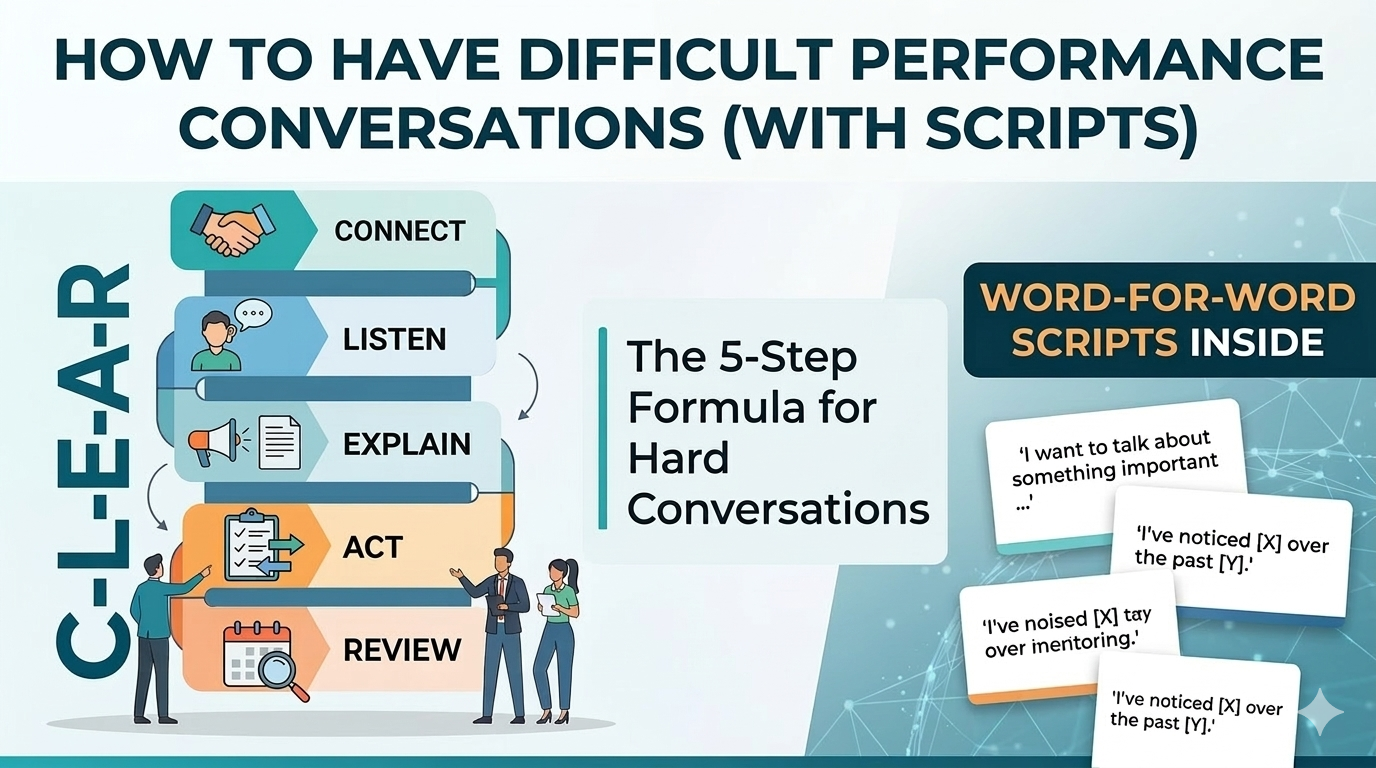
    In this guide, you’ll get a practical CLEAR framework for structuring these conversations with confidence, along with word-for-word scripts you can adapt starting today.

    The Data Behind Difficult Feedback: What Happens When Managers Stay Silent

    If you’ve been putting off a tough performance conversation, you’re not alone — but the cost of waiting is higher than most new managers realize.

    According to DDI’s Global Leadership Forecast, nearly half of managers (46%) admit they struggle to hold employees accountable through direct feedback conversations. And a 2024 Gallup workplace study found that only 26% of employees strongly agree that the feedback they receive helps them do better work. That gap isn’t just a communication problem — it’s a performance problem with a price tag.

    Here’s what the research consistently shows happens when managers go quiet:

    • Disengagement spreads fast. Gallup estimates that low engagement costs organizations approximately $8.8 trillion in lost productivity globally each year. A significant driver? Employees who feel their manager won’t address performance issues fairly. When high performers watch underperformance go unchecked, their own motivation quietly erodes.
    • Resentment builds in both directions. The Society for Human Resource Management (SHRM) reports that unresolved performance issues are among the top five reasons employees cite when leaving a job voluntarily — often framed as a management or culture problem rather than a compensation one.

    The CLEAR Framework: A Repeatable Structure for Hard Conversations

    One of the biggest reasons difficult performance conversations go sideways is that managers walk in without a structure. When you’re nervous, it’s easy to either over-explain, soften the message into meaninglessness, or skip straight to “fix this” without ever truly connecting. The CLEAR framework gives you a repeatable, five-step sequence that keeps the conversation focused, fair, and forward-moving — every time.

    C — Context: State the Specific Behavior, Not the Person

    Anchor the conversation in observable facts, not character judgments. This immediately lowers defensiveness because you’re discussing what happened, not who they are.

    The CLEAR Framework in Action

    L — Listen First: Open With a Question Before Delivering Feedback

    Before you diagnose, get curious. Asking a question first signals respect and often surfaces information that changes your entire approach.

    “Before I share my perspective, can you walk me through how those deadlines felt from your side?”

    E — Expectations: Restate the Standard Clearly

    Don’t assume the employee knows the expectation — say it plainly. Clarity here removes the “I didn’t know” loop that stalls progress.

    “The standard for this role is that all reports land in my inbox by 5 p.m. every Friday.”

    A — Action: Agree on a Specific, Observable Next Step

    Vague next steps create vague results. Collaborate on one concrete action so accountability is mutual, not imposed.

    “Let’s agree that you’ll send me a draft by Thursday noon so we have a buffer. Does that work for you?”

    R — Review: Set a Follow-Up Date

    Closing without a checkpoint sends the message that the conversation was just venting. A scheduled review shows you’re invested in their success.

    “Let’s reconnect on this in two weeks — I’ll put it on the calendar now.”

    When you follow CLEAR consistently, you shift difficult performance conversations from confrontations into coached problem-solving sessions. Employees feel heard before they feel judged, expectations are never ambiguous, and both parties leave with a shared commitment rather than a lingering sense of unresolved tension.

    Step-by-Step Guide to Delivering a Performance Conversation (With Word-for-Word Scripts)

    Difficult performance conversations for managers don’t have to spiral into conflict or awkwardness. Use the CLEAR framework — Connect, Listen, Explain, Act, Review — to keep the conversation focused and productive.

    Step 1: Prepare Before You Walk In

    Write down one or two specific, observable behaviors — not personality judgments. “Missed three deadlines in six weeks” is concrete. “Bad attitude” is not. Also decide your non-negotiable outcome: what must change, and by when.

    Step 2: Connect — Open With Respect

    Start by setting a calm, private tone. Avoid ambushing anyone in a hallway or open office.

    “I want to talk about something important, and I want to do it in a way that’s fair to you. I’ve noticed that [specific behavior] over the past [timeframe]. Can you help me understand what’s been happening?”

    This opening signals respect and invites dialogue rather than defensiveness.

    Step 3: Listen — Give Them Space to Respond

    After your opening, stop talking. Let the employee respond fully before you problem-solve. You may learn context that changes the picture — or you’ll confirm the issue is behavioral.

    Step 4: Explain — Be Clear About the Standard

    Once you’ve heard them out, name the expectation plainly.

    “The standard we need is [X]. I want to support you in getting there — what would help?”

    If defensiveness surfaces, acknowledge it briefly:

    “I hear that this feels frustrating. The goal here isn’t to put you on the spot — it’s to figure out how we move forward together.”

    Then redirect to solutions.

    Step 5: Act and Review — Close With a Concrete Plan

    End every conversation with a specific next step and a follow-up date. Vagueness kills accountability.

    “Let’s check in on [date] to see how [specific action] is going. I’ll document what we discussed so we’re both clear.”

    Document the conversation in writing — even a short email summary protects you both and reinforces seriousness.

    5 Common Mistakes New Managers Make in Feedback Conversations — And How to Fix Them

    Even well-intentioned managers stumble in difficult performance conversations. Here’s what to watch for — and how to course-correct.

    1. Waiting too long. When you delay addressing small issues, they quietly compound into bigger problems. By the time you finally speak up, the employee is blindsided and you’re managing a crisis instead of a conversation.
    2. Being vague instead of behavioral. Telling someone they need to “be more professional” or “show more initiative” gives them nothing actionable to change. Replace adjectives with observable actions and specific examples.
  • Emotional Intelligence for New Managers in 2026

    Emotional Intelligence for New Managers in 2026

    You’ve just been promoted to your first management role, and suddenly the technical skills that got you here aren’t enough. You’re navigating tense team meetings, mediating conflicts between remote and in-office employees, and struggling to read the room on video calls. Welcome to the greatest challenge facing new managers today: mastering emotional intelligence in an increasingly complex workplace.

    Emotional intelligence for new managers has never been more critical.

    As we move through 2026, the workplace landscape demands a fundamentally different leadership approach. AI tools now handle many analytical tasks, leaving human managers to focus on what technology cannot replicate: building trust, inspiring teams, and navigating the nuanced emotional landscape of hybrid work environments. Today’s new managers must lead multigenerational teams spanning Gen Z to Baby Boomers, each with distinct communication preferences and workplace expectations, while maintaining cohesion across distributed teams that rarely meet face-to-face.

    The research is clear: managers with strong EQ for managers outperform their peers by nearly 20% in team productivity and retention metrics. Yet most leadership emotional intelligence development happens through trial and error—a costly approach for both new managers and their organizations. New manager soft skills, particularly emotional intelligence competencies, now rank as the top predictor of leadership success, surpassing traditional metrics like technical expertise or strategic thinking.

    This comprehensive guide will equip you with evidence-based strategies to develop your emotional intelligence across five core competencies: self-awareness, self-regulation, motivation, empathy, and social skills. You’ll learn practical techniques to apply immediately, assessment tools to measure your progress, and real-world scenarios that transform theoretical knowledge into leadership capability.

    The transition from individual contributor to manager is challenging enough, but research shows that technical skills alone won’t guarantee success. According to a landmark study by TalentSmart, emotional intelligence accounts for 58% of performance in all types of jobs, with this figure rising even higher for leadership positions. For new managers specifically, developing emotional intelligence isn’t just beneficial—it’s essential for survival and success in today’s complex workplace.

    The case for prioritizing emotional intelligence for new managers has never been stronger. While IQ and technical expertise might land you the promotion, EQ leadership skills determine whether you’ll thrive in the role. Research from the Center for Creative Leadership found that 75% of careers are derailed for reasons related to emotional competencies, including inability to handle interpersonal problems, unsatisfactory team leadership, and failure to adapt to change.

    Today’s new managers face unprecedented challenges that make manager emotional awareness critical. Leading AI-augmented teams requires the human skills that technology cannot replicate—empathy, motivation, and relationship building. As artificial intelligence handles routine tasks, your value as a manager increasingly lies in your ability to connect with, inspire, and develop your people. Remote and hybrid work environments have eliminated casual hallway conversations and visual cues, making it harder to gauge team morale and address concerns before they escalate. Without strong emotional intelligence, these invisible problems fester.

    Generational diversity adds another layer of complexity. Today’s managers often lead teams spanning four generations, each with different communication preferences, work styles, and motivational drivers. Emotional intelligence equips you to navigate these differences effectively, adapting your leadership approach to meet diverse needs without losing consistency.

    The business impact is measurable. Teams led by emotionally intelligent managers experience 20% higher productivity and significantly lower turnover rates. Perhaps most importantly, emotional intelligence directly creates psychological safety—the foundation of high-performing teams where people feel safe taking risks, admitting mistakes, and bringing their full selves to work. For first-time managers, developing these competencies isn’t a soft skill luxury; it’s the hard skill that determines whether your team succeeds or struggles in an increasingly complex workplace environment.

    The Five Pillars of Emotional Intelligence Every New Manager Must Develop

    Developing emotional intelligence isn’t a nebulous concept—it’s built on five concrete pillars that every new manager can strengthen with deliberate practice. Understanding these foundational EQ skills for leaders gives you a roadmap for growth that directly impacts your team’s performance and engagement.

    Self-Awareness forms the foundation of all emotional intelligence work. As a new manager, this means identifying your emotional triggers before they derail important conversations. Perhaps you become defensive when your ideas are challenged, or you shut down when faced with conflict. This week, start a simple trigger journal: after each team interaction that felt charged, write down what happened and what emotion arose. This practice of self-awareness in management helps you recognize patterns before they become problems.

    Self-Regulation builds on that awareness by giving you tools to manage your responses. When a team member misses a deadline or pushes back on your direction, your ability to pause before reacting separates effective leaders from reactive ones. Try the «90-second rule» this week: when you feel frustration rising, give yourself 90 seconds before responding. Take a brief walk, breathe deeply, or simply count to ten.

    Motivation in emotionally intelligent leadership means connecting your daily work to larger purpose—and helping your team do the same. Start each week by identifying one aspect of your role that genuinely energizes you, then share that enthusiasm authentically with your team. Intrinsic motivation is contagious.

    Empathy requires actively understanding your team members’ perspectives, not just hearing their words. This week, practice reflective listening in your one-on-ones: summarize what you’re hearing before offering solutions. «It sounds like you’re feeling overwhelmed by the project timeline—is that right?» This simple shift demonstrates that you’re truly listening.

    Social Skills encompass everything from conflict resolution to feedback delivery. The most immediate way to strengthen this pillar is implementing the «feedback sandwich» correctly: specific praise, constructive guidance, and encouragement. Practice giving one piece of developmental feedback this week using this structure, focusing on behavior rather than personality.

    Developing emotional intelligence through these five pillars isn’t about perfection—it’s about consistent, incremental improvement that compounds over time into exceptional leadership.

    Building Emotional Intelligence as a New Manager: A Practical Framework

    Building emotional intelligence as a new manager doesn’t happen by chance, it requires a structured leadership development framework. Here’s a practical EQ development plan for managers that delivers measurable results.

    Step 1: Conduct an EQ Self-Assessment

    Begin with honest self-evaluation. Request 360-degree feedback from your supervisor, peers, and direct reports to identify blind spots in how you manage emotions and relationships. This comprehensive view reveals gaps between your self-perception and how others experience your leadership.

    Step 2: Identify Your Top 2 Development Areas

    Rather than tackling everything at once, focus on two specific emotional intelligence competencies. Perhaps you excel at empathy but struggle with emotional regulation during high-pressure situations. Or maybe self-awareness is strong, but relationship management needs work. Prioritization creates momentum.

    Step 3: Practice Daily Micro-Habits

    EQ development happens through consistent small actions. Start each morning with five minutes of reflective journaling about yesterday’s emotional responses. During meetings, practice active listening by summarizing what others say before responding. When triggered, implement a pause-before-responding technique—count to three and take a breath before reacting to challenging situations.

    Step 4: Seek Coaching or Mentorship Support

    While self-directed learning matters, emotional intelligence coaching accelerates your development significantly. An experienced executive coach provides objective feedback, helps you recognize patterns you can’t see yourself, and holds you accountable to your growth goals. Many first-time managers find that working with a leadership coach reduces the learning curve from years to months.

    Step 5: Measure Progress Through Feedback and Reflection

    Schedule quarterly check-ins to evaluate your progress. Request informal feedback from team members on specific behaviors you’re developing. Review your journal entries to identify patterns and improvements. Track concrete outcomes like reduced team conflict, improved one-on-one conversations, or better stress management during deadlines.

    This framework transforms emotional intelligence from an abstract concept into tangible leadership capability, positioning you for long-term success as a manager.

    Common EQ Mistakes New Managers Make (And How to Avoid Them)

    Even well-intentioned new managers stumble when developing emotional intelligence. Here are the most common pitfalls and how to sidestep them.

    Confusing Empathy with Being a Pushover

    Many new managers fear that showing empathy means they can’t hold standards. The truth? Empathetic leaders actually drive better performance. You can acknowledge someone’s stress about a deadline while still maintaining accountability. Practice saying:

    «I understand this is challenging, and I’m confident you can work through it. What support do you need?»

    Ignoring Your Own Emotional Needs

    You can’t pour from an empty cup. New managers often sacrifice their well-being to prove themselves, leading straight to burnout. Schedule non-negotiable time for activities that recharge you. Monitor your stress signals—irritability, fatigue, or cynicism—and address them proactively.

    Avoiding Difficult Conversations

    Postponing tough feedback doesn’t make it easier; it makes problems worse. Emotionally intelligent managers address issues early with curiosity rather than judgment. Frame conversations around impact and future improvement:

    «I noticed the report was submitted late. This affected the client timeline. Let’s discuss what happened and how we can prevent this going forward.»

    Using One-Size-Fits-All Communication

    Your direct reports aren’t all motivated by the same things. Some need detailed direction; others want autonomy. Some prefer written communication; others think best out loud. Invest time learning each person’s preferences and adapt accordingly. This flexibility is emotional intelligence in action.

    Relying on Authority Instead of Influence

    «Because I’m the manager» might get compliance, but it won’t earn commitment. Emotionally intelligent leaders explain the «why,» invite input, and build genuine buy-in. Authority is your title; influence is your impact.

    Conclusion

    Developing emotional intelligence for new managers isn’t an overnight transformation—it’s a continuous journey of self-awareness, empathy, relationship-building, and self-regulation. The encouraging news? EQ is a learnable skill, not a fixed personality trait. Every interaction offers an opportunity to strengthen these capabilities.

    Whether you’re navigating your first leadership role or supporting new managers on your team, professional guidance accelerates growth. At mindslines.com, our executive coaching programs provide personalized strategies to build the emotional intelligence that separates good managers from exceptional leaders. Explore our coaching options today and invest in the leadership skills that will serve you throughout your career.

  • How to Lead Hybrid Teams as a New Manager

    How to Lead Hybrid Teams as a New Manager

    Congratulations on your new management role. Now for the reality check: 73% of first-time managers report that leading hybrid teams is their biggest leadership challenge, according to recent Gartner research. You’re navigating a workplace model that didn’t exist in management textbooks just five years ago, and the stakes are high. Poor hybrid leadership leads to 41% higher turnover rates and significantly lower team engagement scores.

    The good news? Hybrid team management isn’t rocket science—it’s a learnable skill set. This comprehensive guide provides actionable hybrid team management tips for new managers, helping you build trust, drive performance, and create equity across your distributed team. Whether you’re managing two remote employees or leading an entirely distributed team across time zones, these frameworks will set you up for success.

    Why Hybrid Team Leadership Is the Defining Challenge for New Managers

    The transition to first-time manager hybrid work environments creates a perfect storm of complexity. Traditional management relied heavily on physical proximity—observing body language in meetings, casual hallway conversations, and visual cues about workload and morale. Hybrid work removes these informal feedback mechanisms while simultaneously increasing coordination complexity.

    Research from Microsoft’s Work Trend Index shows that hybrid managers spend 43% more time in meetings than their in-office counterparts, yet report feeling less connected to their teams. You’re expected to maintain culture, drive results, and develop talent while your team members work from different locations on different schedules.

    The challenge intensifies because you’re learning management fundamentals while simultaneously mastering a new operational model. It’s like learning to drive stick shift in rush hour traffic. But understanding this challenge is the first step toward overcoming it.

    Building Trust and Psychological Safety in Distributed Teams

    Trust is the foundation of high-performing teams, and it’s exponentially harder to build when you can’t share coffee breaks or read the room during difficult conversations. Leading distributed teams requires intentional trust-building practices that go beyond occasional video calls.

    The Trust Triangle Framework

    Implement what leadership experts call the Trust Triangle: consistency, competence, and care. In hybrid settings, this translates to:

    Consistency: Establish predictable communication patterns. If you say you’ll send weekly updates every Friday at 10 AM, do it without fail. Consistency builds psychological safety because team members know what to expect from you.

    Competence: Demonstrate expertise by making informed decisions and admitting when you don’t know something. New managers often feel pressure to have all the answers. Paradoxically, saying «I don’t know, but I’ll find out» builds more trust than faking expertise.

    Care: Show genuine interest in your team members as whole people. Schedule monthly one-on-ones that aren’t solely performance-focused. Ask about their challenges, career aspirations, and how the hybrid model is working for them personally.

    Transparent Communication Rituals

    Create transparency through structured communication rituals. Share your decision-making process openly, even when delivering unpopular news. When team members understand the «why» behind decisions, trust increases—even if they disagree with the outcome.

    Implement a «default to open» policy where information is shared broadly unless there’s a specific reason for confidentiality. Use shared documents for strategy updates, team goals, and meeting notes so remote and in-office employees have equal access to information.

    Setting Hybrid Team Norms and Communication Rhythms

    The absence of physical proximity means you must explicitly design what many managers previously took for granted. Hybrid team engagement strategies start with co-creating team norms rather than imposing them.

    The Team Charter Exercise

    Within your first 30 days, facilitate a team charter workshop (virtual or hybrid) where you collectively define:

    • Core collaboration hours: When should everyone be available? Many successful hybrid teams establish 10 AM-3 PM as core hours across time zones, with flexibility outside that window.
    • Response time expectations: What’s reasonable for email (24 hours), Slack (4 hours), and urgent issues (immediate)? Clarity prevents resentment.
    • Meeting protocols: Will cameras be required? Can people eat on video calls? Should meetings default to 25 or 50 minutes to allow buffer time?
    • Office day coordination: If your model includes designated office days, align them for maximum collaboration value rather than arbitrary attendance.

    The Communication Hierarchy Model

    Not all communication deserves the same channel. Teach your team this hierarchy:

    1. Urgent and complex: Video call or phone
    2. Important but not urgent: Email with clear subject lines
    3. Quick questions: Team chat with expected response windows
    4. Documentation and decisions: Shared documents or project management tools
    5. Updates and FYIs: Asynchronous updates in designated channels

    This prevents the all-too-common problem of everything feeling urgent and every communication landing in Slack, creating notification overload and fragmented attention.

    Preventing Proximity Bias and Ensuring Equitable Career Growth

    Proximity bias—the tendency to favor employees you see physically—is perhaps the most insidious challenge in how to lead hybrid teams as a new manager. Research shows that remote workers receive 31% fewer promotions and high-visibility assignments compared to their in-office counterparts, even when performance is identical.

    The Equity Audit

    Conduct monthly equity audits by tracking:

    • Who receives stretch assignments and developmental opportunities?
    • Who speaks first and most in hybrid meetings?
    • Whose ideas get attributed and implemented?
    • Who gets informal mentorship and face time with senior leaders?

    If patterns emerge favoring in-office employees, you’re experiencing proximity bias. Awareness is the first step toward correction.

    Deliberate Inclusion Practices

    Implement these structural interventions:

    Round-robin assignments: Systematically rotate high-visibility projects across all team members regardless of location. Keep a spreadsheet to ensure fairness.

    Remote-first meetings: Even when some attendees are in-room together, structure meetings as if everyone is remote. Have in-office participants join from their own computers to level the playing field.

    Skills-based criteria: When selecting who gets developmental opportunities, use explicit criteria related to skills and readiness rather than gut feelings, which are often influenced by proximity.

    Visibility creation: Actively amplify remote employees’ contributions in leadership meetings and company communications. They can’t benefit from hallway conversations with executives, so you must create visibility deliberately.

    Managing Performance and Preventing Burnout in Hybrid Settings

    The shift to hybrid work hasn’t eliminated performance management—it’s complicated it. You can’t manage by walking around or gauge productivity through physical presence. This actually makes you a better manager, forcing outcome-focused leadership rather than activity monitoring.

    Outcomes Over Activity

    Define clear success metrics for each role that focus on results rather than hours logged or attendance. Use the FAST goals framework:

    • Frequently discussed: Goals are reviewed in weekly one-on-ones, not just annual reviews
    • Ambitious: Stretch beyond comfort zones while remaining achievable
    • Specific: Concrete enough that success is measurable
    • Transparent: Visible to the entire team to encourage collaboration

    When performance conversations focus on outcomes, location becomes irrelevant.

    Burnout Prevention Through Boundary Setting

    Hybrid work blurs work-life boundaries, and new managers often inadvertently encourage always-on culture. Combat this through:

    Modeling boundaries: Don’t send messages outside work hours. If you work evenings, schedule emails to send during business hours. Your behavior sets team norms.

    Workload check-ins: In one-on-ones, explicitly ask: «On a scale of 1-10, how sustainable is your current workload?» This simple question surfaces problems before they become crises.

    Recovery time: Require true disconnection during PTO. Don’t contact team members on vacation, and reassign their work clearly so they’re not mentally tracking projects from the beach.

    Energy management: Recognize that back-to-back video calls are cognitively draining. Build breaks into team calendars and encourage «camera optional» for internal meetings when presentation isn’t necessary.

    Creating Connection and Team Cohesion Across Distance

    High-performing teams share strong interpersonal relationships, and building these connections requires intentionality in hybrid environments. The spontaneous bonding that happens naturally in offices won’t happen automatically in distributed teams.

    Structured Social Connection

    Schedule quarterly virtual or in-person team experiences that prioritize relationship-building over work discussions. This might include:

    • Virtual coffee randomization where team members are paired monthly for 30-minute non-work conversations
    • Team retrospectives focused on «what’s working well» to build shared positive experiences
    • Optional virtual co-working sessions where people work independently but together, recreating the office ambiance some employees miss

    The key word is «structured.» Hope is not a strategy for team cohesion.

    Celebrating Wins Publicly and Consistently

    Remote employees often feel invisible when achievements go unrecognized. Create a weekly recognition ritual in team meetings or Slack channels where you highlight specific contributions. Be concrete: «Jamal’s analysis of customer churn patterns directly influenced our product roadmap» is more meaningful than «great job, Jamal.»

    The Role of Coaching in Developing Hybrid Leadership Skills

    Here’s an uncomfortable truth: most new managers receive promotions based on individual contributor performance, not leadership capability. You’re expected to excel at skills you’ve never been taught, in a work environment that’s unprecedented.

    Professional coaching accelerates your development by providing personalized guidance, accountability, and a confidential space to navigate challenges. Leadership coaches help you:

    • Develop your unique management style rather than imitating others poorly
    • Process difficult situations and emotions without burdening your team
    • Identify blind spots that informal feedback won’t surface
    • Build strategic thinking capabilities that transcend tactical firefighting
    • Navigate organizational politics and stakeholder management

    Many successful managers consider coaching the differentiator between surviving and thriving in their first leadership role. It’s particularly valuable in hybrid settings where you can’t learn by osmosis from experienced managers in the next cubicle.

    Frequently Asked Questions About Leading Hybrid Teams

    How do I know if my hybrid team is truly engaged or just going through the motions?

    Look beyond attendance metrics to engagement indicators: Are team members volunteering ideas in meetings? Do they ask clarifying questions about strategy? Are they collaborating across functions without your prompting? Conduct quarterly anonymous pulse surveys asking specific questions: «Do you understand how your work contributes to company goals?» and «Do you feel your voice is heard in team decisions?» Declining scores are early warning signals. Additionally, watch for decreased camera usage, minimal chat participation, and one-word responses—these often signal disengagement before it shows up in performance metrics.

    What should I do if some team members want more office time while others prefer fully remote?

    This tension is normal and requires facilitated conversation rather than mandate. First, understand the underlying needs: Is the office-preferring employee seeking social connection, better workspace, or separation from home distractions? Is the remote-preferring employee managing caregiving responsibilities, avoiding commute time, or working more productively in solitude? Once you understand needs, you can address them creatively. Perhaps office-preferring employees come in on aligned days for maximum collaboration, while remote employees get upgraded home office equipment. The goal isn’t uniform behavior—it’s meeting diverse needs while maintaining team cohesion. Document agreements in your team charter and revisit quarterly.

    How can I give constructive feedback effectively in a hybrid environment?

    Never deliver constructive feedback via email or chat—tone is too easily misinterpreted. Schedule video calls where you can read facial expressions and respond to reactions in real-time. Use the SBI framework: Situation («In yesterday’s client meeting»), Behavior («when you interrupted the client mid-sentence»), Impact («they became visibly frustrated and we lost the thread of their concern»). Then pivot to collaborative problem-solving: «What was happening for you in that moment?» and «How can we approach similar situations differently?» Follow up with a brief written summary so there’s documented clarity, but the emotional labor happens face-to-face. Schedule feedback conversations regularly, not just when problems arise, so they don’t feel punitive.

    Building Your Hybrid Leadership Capabilities

    Leading hybrid teams as a new manager is undeniably challenging, but it’s also an opportunity to build leadership capabilities that will serve you throughout your career. The skills you develop now—intentional communication, equitable treatment, outcome-focused management, and adaptive leadership—are the future of management regardless of where work happens.

    Remember that perfect execution isn’t the goal; continuous improvement is. You’ll make mistakes. You’ll have meetings that flop and initiatives that don’t land. What separates successful hybrid managers from struggling ones isn’t flawless performance—it’s the willingness to solicit feedback, adjust approaches, and keep developing.

    If you’re feeling overwhelmed by the complexity of first-time manager hybrid work, you’re not alone. At Mindslines, we specialize in coaching new managers through exactly these challenges. Our leadership coaches work one-on-one with emerging leaders to accelerate their development, navigate complex team dynamics, and build confidence in their leadership identity. Whether you’re looking for individual coaching or developing a cohort of new managers across your organization, our evidence-based approach helps leaders move from surviving to thriving.

    Ready to elevate your hybrid leadership skills? Explore Mindslines’ coaching programs designed specifically for new managers navigating the complexities of distributed team leadership. Because the best investment you can make in your team’s success is investing in your own development first.

  • How to Coach and Develop Your Team: First-Time Manager Guide

    How to Coach and Develop Your Team: First-Time Manager Guide

    The Coaching Challenge Every First-Time Manager Faces

    You’ve just been promoted to your first management role. Congratulations! But now you’re facing a reality that no one adequately prepared you for: your team’s success depends on your ability to develop them, not just direct them.

    Most first-time managers struggle with coaching. You might find yourself defaulting to simply telling people what to do—it’s faster, feels more certain, and honestly, it’s what you probably experienced from your own managers. But effective coaching and development separates good managers from great ones, and it’s the single most impactful investment you can make in your team’s long-term performance.

    This guide provides a practical framework for coaching your team members, complete with real conversation examples and strategies adapted for today’s remote and hybrid work environments. Whether you’re managing in-person, remotely, or somewhere in between, you’ll learn how to develop your team’s capabilities while building the confidence you need as a new leader.

    Why Coaching Matters More Than Ever for First-Time Managers

    As a first-time manager, your success metric has fundamentally changed. You’re no longer evaluated primarily on your individual contributions, you’re now measured by your team’s collective output and growth.

    Coaching delivers three critical benefits that directly impact your effectiveness:

    • Sustainable Performance: When you coach team members to solve problems themselves, you create lasting capability. Directing them gives you a solution today; coaching them builds the skills they’ll use for months and years ahead.
    • Reduced Bottlenecks: Every time you simply provide answers, you train your team to come back to you with the next question. Effective coaching develops independent critical thinkers who can navigate challenges without constant supervision.
    • Employee Retention and Engagement: Recent research consistently shows that professional development opportunities rank among the top reasons employees stay with organizations. Your coaching directly impacts whether your best people choose to grow with you or grow elsewhere.

    For first-time managers specifically, coaching also serves a fourth purpose: it helps you transition from being the person with all the answers to being the person who helps others find their own answers. This identity shift is emotionally challenging but absolutely essential.

    Understanding the Critical Differences: Coaching, Mentoring, and Directing

    Before diving into coaching techniques, you need to understand when to coach versus when to use other leadership approaches. Many first-time managers struggle because they try to coach in situations that require direction, or they direct when coaching would be more effective.

    Directing: When Speed and Compliance Matter

    Directing means telling someone exactly what to do and how to do it. Use this approach when:
    – There’s a compliance, safety, or legal requirement
    – Time is genuinely critical with no room for learning delays
    – The person is completely new to a task and has no foundation to build from

    Example: «We need to submit this regulatory report by 3pm using the exact format in the compliance folder. Let me show you the required steps.»

    Mentoring: Sharing Your Experience and Guidance

    Mentoring involves sharing your own experiences, offering advice, and providing guidance based on what worked for you. Use this when:
    – Someone asks for your perspective or career guidance
    – You’re helping them navigate organizational politics or culture
    – You’re discussing long-term career development

    Example: «When I was in your position, I found that building relationships with the finance team early made budget season much smoother. Here’s what I learned…»

    Coaching: Developing Their Problem-Solving Capacity

    Coaching means asking questions that help someone develop their own insights and solutions. Use this when:
    – The person has foundational knowledge but needs to build judgment
    – Development and learning are as important as the immediate outcome
    – Multiple valid approaches exist and they need to find what works for them
    – You want to build long-term capability and independent thinking

    Example: «You’ve identified three possible approaches. What criteria matter most for this decision? What would each approach accomplish?»

    Most first-time managers over-rely on directing because it feels more comfortable and certain. Challenge yourself to coach whenever the situation allows for it.

    The GROW Framework: Your Step-by-Step Coaching Structure

    The GROW model provides a proven structure for coaching conversations. It’s simple enough to remember under pressure but sophisticated enough to drive real development.

    Goal: Establish What They Want to Achieve

    Start by clarifying what success looks like for this specific conversation or development area.

    Coaching questions:
    – «What would you like to accomplish in our conversation today?»
    – «What does success look like for this project/skill/situation?»
    – «If you could wave a magic wand, what would be different?»

    This step ensures you’re coaching toward their objectives, not your assumptions about what they need.

    Reality: Explore the Current Situation

    Help them assess where things stand now, including obstacles, resources, and context.

    Coaching questions:
    – «What’s happening now? Walk me through the current situation.»
    – «What have you already tried?»
    – «What’s working well? What’s not working?»
    – «What resources or support do you have available?»

    Listen more than you talk during this phase. Your job is to help them see their situation more clearly, not to immediately solve it.

    Options: Generate Possible Approaches

    Guide them to identify multiple possible solutions or paths forward.

    Coaching questions:
    – «What options do you see?»
    – «What else could you try?»
    – «If you had unlimited resources, what would you do?»
    – «What would you advise a colleague in this situation?»

    Resist the urge to immediately suggest your own solutions. Even if their initial ideas aren’t optimal, the process of generating options builds their strategic thinking muscles.

    Way Forward: Commit to Specific Actions

    Help them choose an approach and create concrete next steps with accountability.

    Coaching questions:
    – «Which option feels most promising to you? Why?»
    – «What will you do first? By when?»
    – «What might get in the way? How will you handle that?»
    – «How will you know if this is working?»
    – «What support do you need from me?»

    End every coaching conversation with clear commitments and a plan to follow up.

    Real Coaching Conversations: What It Actually Sounds Like

    Theory is helpful, but first-time managers need to hear what effective coaching actually sounds like in practice. Here are two realistic scenarios.

    Scenario 1: Coaching Through a Difficult Stakeholder Relationship

    Team member: «I’m really frustrated with the marketing team. They keep changing requirements after we’ve already started development.»

    Ineffective (directing) response: «You need to set clearer boundaries. Tell them we need final requirements before development starts.»

    Effective (coaching) response:

    *You:* «That does sound frustrating. What impact is this having on your work?» [Reality]

    *Team member:* «We’re wasting time rebuilding things, and I’m worried about missing our deadline.»

    *You:* «Those are legitimate concerns. What would an ideal working relationship with marketing look like?» [Goal]

    *Team member:* «They’d give us complete requirements upfront, or at least flag changes earlier so we can adjust.»

    *You:* «Good. What might be driving their behavior? What do you know about their situation?» [Reality – expanding perspective]

    *Team member:* «Actually, I think their leadership keeps changing priorities on them too. They’re probably just reacting.»

    *You:* «Interesting insight. So what are some ways you could work with that reality?» [Options]

    *Team member:* «Maybe I could set up a weekly sync to catch changes earlier? Or help them understand our process better so they see the impact?»

    *You:* «Both sound promising. Which would you like to try first?» [Way Forward]

    Notice how coaching helped them move from frustration to understanding to action—a journey they wouldn’t have taken if you’d simply directed them.

    Scenario 2: Coaching for Skill Development

    Team member: «I got feedback that my presentations need work, but I’m not sure what to change.»

    You: «Let’s work through this together. What specifically did the feedback say?» [Reality]

    Team member: «That I need to be more concise and lead with the main point.»

    You: «Okay. When you think about your last presentation, how did you structure it?» [Reality]

    Team member: «I walked through all our research and analysis, then shared the recommendation at the end.»

    You: «What do you think your audience needed most from that presentation?» [Expanding perspective]

    Team member: «Probably the recommendation and why we’re confident in it. The detailed research was more for if they had questions.»

    You: «Exactly. So how might you structure your next presentation differently?» [Options]

    Team member: «Start with the recommendation, share the key supporting points, then have the detailed analysis as backup?»

    You: «That’s a strong approach. Want to practice that structure with your upcoming quarterly review presentation?» [Way Forward]

    Team member: «Yes. Could I do a practice run with you beforehand?»

    You: «Absolutely. Let’s schedule 30 minutes next Tuesday.» [Support and accountability]

    Coaching Remote and Hybrid Teams: Adapting Your Approach

    If you’re managing a remote or hybrid team, you face additional coaching challenges. Distance reduces informal learning opportunities and makes it harder to read emotional cues. Here’s how to adapt:

    Create Structured Coaching Cadences

    Without hallway conversations, you need intentional coaching touchpoints. Schedule:
    – Weekly one-on-ones (minimum 30 minutes, protected time)
    – Monthly development conversations focused specifically on growth
    – Quarterly reviews of progress against development goals

    Make these meetings sacred—don’t cancel them for «more urgent» work.

    Use Video for Meaningful Coaching Conversations

    Never coach on significant topics over email or chat. Video allows you to:
    – Read facial expressions and body language
    – Build stronger rapport and trust
    – Demonstrate that you’re fully present and engaged

    Turn your camera on and ask them to do the same for coaching conversations.

    Document Coaching Conversations and Commitments

    With remote teams, follow-up is harder. After coaching conversations:
    – Send a brief summary of commitments and next steps
    – Add action items to a shared development tracker
    – Schedule specific follow-up conversations

    This creates accountability and shows you’re invested in their growth.

    Leverage Asynchronous Coaching Tools

    Not every coaching moment requires real-time conversation. Use:
    – Recorded video feedback on presentations or work products
    – Collaborative documents where they can reflect on questions you pose
    – Shared learning resources with discussion prompts

    These tools can actually enhance coaching by giving team members time to think deeply before responding.

    Managing Your Own Development as a Coach

    Here’s something most leadership advice won’t tell you: coaching as a first-time manager feels uncomfortable and inefficient at first. You’ll be tempted to abandon it and return to directing.

    That discomfort is normal and valuable. Here’s how to push through it:

    Start Small and Build Your Coaching Muscles

    Don’t try to coach every conversation immediately. Pick one team member or one recurring situation and practice coaching there first. As it becomes more natural, expand your coaching to other contexts.

    Reflect on Your Coaching Conversations

    After coaching conversations, ask yourself:
    – Did I talk more than they did? (If yes, you were probably directing, not coaching)
    – Did I ask questions that generated new thinking?
    – What will I do differently next time?

    This reflection accelerates your development as a coach.

    Find Your Own Coach or Peer Support

    You can’t pour from an empty cup. Seek out:
    – A more experienced manager who can coach you on your coaching
    – Peer first-time managers to share challenges and approaches
    – Leadership development programs focused on coaching skills

    Coaching is a skill that improves with practice and feedback, just like any other.

    Give Yourself Permission to Switch Modes

    You don’t have to coach perfectly or exclusively. Some situations genuinely require directing. What matters is becoming more intentional about when you coach versus when you direct, and gradually increasing the percentage of coaching in your leadership approach.

    Key Takeaways: Your Coaching Development Plan

    Learning how to coach and develop your team as a first-time manager is a journey, not a destination. Here’s how to start:

    This week:
    – Identify one upcoming conversation where you can practice coaching instead of directing
    – Use the GROW framework to structure that conversation
    – Reflect on how it went and what you learned

    This month:
    – Establish regular one-on-one meetings with each team member if you haven’t already
    – Practice coaching in at least three different situations
    – Ask for feedback: «How helpful was our conversation? What would make our coaching time more valuable?»

    This quarter:
    – Create individual development plans with each team member
    – Track your ratio of coaching versus directing conversations
    – Identify your own coach or peer support system

    Remember: your team’s growth is your growth. Every coaching conversation is an investment in their capabilities and your effectiveness as a leader. The discomfort you feel while learning to coach is actually a sign that you’re expanding your leadership capacity.

    Your success as a first-time manager depends less on having all the answers and more on helping your team develop the ability to find answers themselves. Start coaching today, even imperfectly, and you’ll be amazed at what your team can accomplish.

  • First-Time Manager Training 2026: AI-Integrated Frameworks for New Leaders

    First-Time Manager Training 2026: AI-Integrated Frameworks for New Leaders

    The transition from individual contributor to manager remains one of the most challenging career pivots professionals face. Yet as we move through 2026, the landscape of first-time manager training has fundamentally transformed. Traditional management courses that once dominated corporate learning catalogs are giving way to dynamic, AI-integrated programs that address the realities of hybrid work, digital collaboration, and the psychological demands of modern leadership.

    If you’re preparing to step into a management role—or responsible for developing new managers—understanding these shifts isn’t optional. It’s the difference between thriving and merely surviving in today’s leadership environment.

    Why Traditional First-Time Manager Training Falls Short in 2026

    The conventional approach to new manager onboarding typically involves a two-day workshop, maybe a leadership book, and the optimistic assumption that people will «figure it out.» This model fails because it ignores three critical realities:

    First, new managers now lead distributed teams where 73% of employees work in hybrid or fully remote arrangements. The skills required to motivate someone you see twice a month differ dramatically from traditional office management.

    Second, today’s managers must navigate AI collaboration tools, digital performance metrics, and asynchronous communication—none of which appeared in management training programs even five years ago. Digital literacy isn’t a nice-to-have; it’s foundational to effective leadership.

    Third, the psychological toll of management has intensified. First-time managers report 60% higher stress levels than their individual contributor peers, yet most training programs dedicate zero time to mental resilience, boundary-setting, or sustainable leadership practices.

    The content gap is clear: aspiring managers don’t need another course roundup. They need actionable frameworks that integrate AI tools, address hybrid team dynamics, and build psychological resilience from day one.

    The 2026 Framework for First-Time Manager Training

    Effective leadership development in 2026 requires a structured approach that balances technical skills, emotional intelligence, and digital fluency. Here’s the framework that actually prepares new managers for success:

    Foundation 1: AI-Augmented Leadership Skills

    The most successful manager training programs now incorporate AI literacy as a core competency. This doesn’t mean learning to code—it means understanding how to leverage AI tools for better decision-making, communication, and team development.

    Practical applications include:

    – Using AI-powered analytics to identify team performance patterns before they become problems

    – Leveraging natural language processing tools to analyze communication effectiveness and team sentiment

    – Implementing AI coaching assistants that provide real-time feedback during difficult conversations

    – Automating routine management tasks to preserve time for high-value human interactions

    The key insight: AI doesn’t replace management judgment; it amplifies it. First-time managers who embrace this reality outperform peers who view technology as separate from leadership.

    Foundation 2: Hybrid Team Management Mastery

    Managing hybrid teams requires fundamentally different skills than traditional office management. Your new manager onboarding must explicitly address these scenarios:

    Asynchronous communication excellence: Train managers to craft clear, complete written communications that eliminate unnecessary meetings. This includes structuring decision memos, providing context-rich feedback, and documenting thought processes that remote team members can access on their schedule.

    Presence without proximity: Develop strategies for building genuine relationships across digital channels. This means moving beyond transactional Slack messages to intentional one-on-ones, virtual coffee chats, and creating space for informal connection that once happened naturally in offices.

    Equitable visibility management: Address the documented bias where in-office employees receive more recognition and opportunities. Implement systems that ensure remote team members have equal access to high-visibility projects, mentorship, and career development.

    Digital body language fluency: Train managers to read engagement signals in video calls, interpret message timing and tone, and recognize when someone is struggling despite saying they’re «fine» in text.

    Foundation 3: The Resilience-First Approach

    The dirty secret of management: the role fundamentally changes your relationship with work, and most new managers aren’t prepared for the psychological shift.

    A resilience-first approach to first-time manager training addresses this proactively:

    Boundary architecture: Before new managers take on their first report, teach them to establish sustainable work boundaries. This includes defining response-time expectations, protecting focus time, and modeling healthy work-life integration for their team.

    Emotional regulation techniques: Management involves constant context-switching between strategic thinking and interpersonal challenges. Train specific techniques like the «90-second rule» for processing emotional reactions before responding, and cognitive reframing for high-stress situations.

    Decision-making frameworks under uncertainty: New managers often freeze when facing ambiguous situations with incomplete information. Provide structured frameworks like the RAPID model (Recommend, Agree, Perform, Input, Decide) that clarify decision rights and reduce analysis paralysis.

    Peer support systems: Isolation is one of the biggest challenges for first-time managers. Build cohort-based learning where new managers share experiences, troubleshoot challenges together, and normalize the struggle of stepping into leadership.

    Implementing Your Manager Training Program: The 90-Day Blueprint

    Theory matters less than execution. Here’s how to structure a new manager’s first 90 days for maximum effectiveness:

    Days 1-30: Foundation and Assessment

    Begin with a comprehensive skills assessment that identifies individual strengths and development areas. Pair new managers with experienced mentors who meet weekly for the first month.

    Introduce core management frameworks: effective one-on-ones, feedback models (like SBI: Situation-Behavior-Impact), and basic performance management. Keep it simple and immediately applicable.

    Schedule «shadow sessions» where new managers observe experienced leaders handling common scenarios: delivering difficult feedback, running team meetings, navigating conflicts.

    Days 31-60: Application and Iteration

    Transition from learning to doing. New managers should now run their own one-on-ones, team meetings, and begin making independent decisions with mentor backup.

    Introduce AI tools relevant to your organization. Provide hands-on training in whatever systems your managers will actually use—whether that’s performance analytics platforms, communication tools, or project management software.

    Conduct mid-point feedback sessions where new managers reflect on challenges, celebrate wins, and adjust their approach based on early results.

    Days 61-90: Integration and Independence

    By month three, new managers should operate independently while maintaining regular mentor check-ins. Focus shifts to strategic thinking: How does their team’s work connect to broader organizational goals? What culture are they actively building?

    Introduce more complex scenarios: handling underperformance, managing team conflicts, advocating for resources. Use case studies and role-playing to build confidence before real situations arise.

    Conduct a comprehensive 90-day review that assesses progress, identifies ongoing development needs, and transitions the new manager to long-term leadership development programs.

    Measuring What Matters: Beyond Course Completion Rates

    Traditional training metrics—completion rates, satisfaction scores—tell you almost nothing about whether your first-time manager training actually works. Instead, measure:

    Team engagement scores: Do reports feel supported, heard, and developed? Survey team members at 90 and 180 days.

    Manager confidence metrics: Track selfreported confidence in handling common management scenarios over time.

    Retention rates: Both of the new manager and their team members. High turnover signals training gaps.

    Time-to-competency: How quickly do new managers achieve independence in core responsibilities?

    Business outcomes: Ultimately, does the manager’s team deliver results? Track productivity, quality, and goal achievement.

    The Technology Stack for Modern Manager Development

    The right tools amplify your leadership development efforts. Consider integrating:

    AI coaching platforms that provide personalized feedback and simulate difficult conversations for practice

    Learning management systems with microlearning capabilities for just-in-time training

    Peer learning platforms that facilitate cohort discussions and knowledge sharing

    Performance management tools that make ongoing feedback and goal-tracking effortless

    Analytics dashboards that help new managers understand team dynamics and identify issues early

    The key is integration: these tools should work together seamlessly rather than creating additional administrative burden.

    Common Pitfalls in First-Time Manager Training (And How to Avoid Them)

    Even well-intentioned programs often stumble. Watch for these failure patterns:

    Information overload: Dumping 40 hours of content on new managers in their first week guarantees nothing sticks. Space learning over time and focus on immediately applicable skills.

    Theory without practice: Lectures about leadership principles mean nothing without opportunities to apply them in safe environments. Build in role-playing, simulations, and real-world projects with mentor support.

    One-size-fits-all approaches: A new manager leading software engineers needs different skills than one managing sales reps. Customize training to role-specific challenges.

    Neglecting the identity shift: Moving from peer to manager requires processing feelings about changed relationships. Programs that ignore this emotional dimension fail.

    Insufficient ongoing support: The learning doesn’t stop after the initial training period. Provide continuous development opportunities, refresher sessions, and advanced skills training.

    Looking Forward: The Future of Leadership Development

    As we progress through 2026 and beyond, first-time manager training will continue evolving. Emerging trends include:

    Personalized learning paths powered by AI that adapt to individual manager’s learning styles and challenges

    Virtual reality simulations for practicing difficult conversations and decision-making in psychologically safe environments

    Neuroscience-informed approaches that optimize how we teach leadership skills based on how brains actually learn and change

    Global, asynchronous cohorts that enable peer learning across time zones and cultural contexts

    The organizations that invest in comprehensive, modern first-time manager training gain enormous competitive advantages: higher retention, stronger culture, better business results, and a robust leadership pipeline.

    Your Next Steps

    Becoming an effective manager—or developing effective managers—requires intentional effort and the right framework. The 2026 approach integrates AI literacy, hybrid team management, and psychological resilience into a comprehensive program that actually prepares leaders for today’s challenges.

    Start by assessing your current approach: Does your manager training program address distributed teams? Does it build digital fluency? Does it support mental resilience? If not, you’re preparing managers for a workplace that no longer exists.

    The transition to management will never be easy, but with the right training foundation, it doesn’t have to be as overwhelming as it often feels. Whether you’re stepping into your first leadership role or responsible for developing new managers, the frameworks outlined here provide a roadmap for success in 2026’s leadership landscape.

    Ready to transform your approach to leadership development? Explore how Mindslines can help you build manager training programs that actually work, combining proven frameworks with cutting-edge approaches to create leaders who thrive in today’s hybrid, AI-augmented workplace.

  • The Four Stages of Learning

    The Four Stages of Learning

    As humans, we are constantly learning and growing. Whether we realize it or not, we are always acquiring new knowledge and skills, and adapting to the world around us. However, not all learning is equal, and some methods are more effective than others. Moreover, learnings alone won’t make us grow and transform. We must also transfer the acquired learnings to our specific reality, apply it, and practice its application until it becomes part of how we behave. By understanding the four stages of learning, also known as the four stages of competence, we can develop a more effective approach to personal growth and development.

    There is some debate among scholars and practitioners about the true origin of the four stages of learning model.  Some attributed to Abraham Maslow, but others affirm that the four stages of Learning were introduced by Noel Burch in the 1970s; however, there is evidence the model was first used by Martin M. Broadwell in 1969 in an article where he was explaining the practice of “teaching for learning” using the competence model.  Despite its age, this model remains relevant and widely used today because it provides a clear framework for understanding how we learn and develop new skills. In recent years, advances in neuroscience have confirmed the validity of the model by demonstrating how our brains forms new neural pathways during the learning process. Additionally, the importance of self-awareness and reflective practice in effective learning has become increasingly recognized. The Four Stages of Learning provides a useful tool to assess our own learning and growth, and to become more self-aware in our learning journey.

    Learners in the stages of learning model will find themselves falling into 1 of 4 stages as they transit the learning journey: unconscious incompetence, conscious incompetence, conscious competence, or unconscious competence.

    The four stages of learning

    Stage 1: Unconscious Incompetence

    The first stage of learning is known as unconscious incompetence. At this stage, we are unaware of our own lack of knowledge or skills. We may not even realize that there is something we need to learn or improve upon. This can lead to complacency and a lack of motivation to change. To progress to the next stage, we need to recognize that there is a gap in our knowledge or skills.

    Stage 2: Conscious Incompetence

    The second stage of learning is conscious incompetence. At this stage, we become aware of our own lack of knowledge or skills, but we are not yet proficient in the desired behavior or skill. This can be a frustrating stage, as we may feel overwhelmed or discouraged by our lack of progress. However, it is important to remember that this stage is an essential part of the learning process. By acknowledging our weaknesses, we can begin to take steps to improve and develop our skills.

    Stage 3: Conscious Competence

    The third stage of learning is conscious competence. At this stage, we have developed the necessary skills or knowledge, but we must still consciously focus on applying them. This can require a great deal of effort and attention, as we may need to break down the behavior or skill into smaller, manageable steps. With practice, we can gradually develop a more automatic and efficient process for applying the skill or behavior.

    Stage 4: Unconscious Competence

    The fourth and final stage of learning is unconscious competence. At this stage, the skill or behavior has become second nature, and we are able to perform it without conscious effort or attention. This stage represents mastery, and it can be a very rewarding experience. However, it is important to remember that even at this stage, there is always room for improvement and growth.

    Applying the Four Stages of Learning for Personal Growth and Development

    By understanding the four stages of learning, we can develop a more effective approach to personal growth and development. Here are some tips for each stage:

    • Unconscious Incompetence: Be open to feedback and self-reflection. Look for areas where you may need to improve and be willing to ask for help when necessary.
    • Conscious Incompetence: Set achievable goals and break down the desired behavior or skill into smaller steps. Celebrate small victories along the way and be patient with yourself as you learn and grow.
    • Conscious Competence: Practice, practice, practice! Focus on applying the skill or behavior in a variety of situations and look for opportunities to receive feedback and refine your approach.
    • Unconscious Competence: Look for ways to continue to challenge yourself and improve. Seek out opportunities for growth and development and be willing to take risks and try new things.

    Conclusion

    The four stages of learning provide a powerful framework for personal growth and development. By understanding these stages and applying them to our own lives, we can become more effective learners and create lasting change in our behaviors and habits. Whether we are looking to develop new skills, overcome bad habits, or simply grow as individuals, the four stages of learning can help us achieve our goals and reach our full potential.